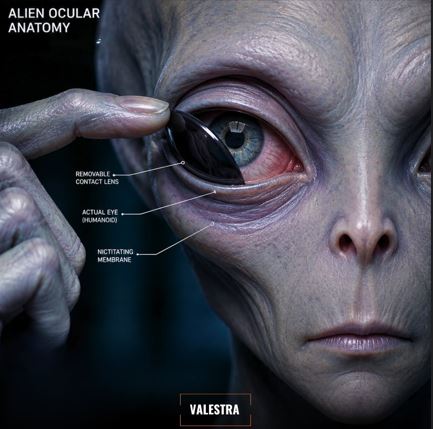
Grey alien eyes may be advanced contact lenses rather than natural organs has fascinated both scientists and enthusiasts for decades. This theory suggests that the large, black, almond shaped eyes often reported in abduction stories might conceal more ordinary eyes beneath sophisticated optical devices. If true, these lenses could allow aliens to interact with humans and their environment in controlled ways while protecting their visual systems from unfamiliar or harsh conditions.
Historical reports from alleged abductees form a significant basis for this theory. Hypnotic regression and anecdotal accounts describe how Grey aliens may remove or manipulate the outer layer of their eyes, revealing smaller, more human-like irises and pupils underneath. Researchers such as Budd Hopkins and John Mack documented these claims, noting patterns of consistency that have intrigued both the UFO research community and comparative biologists exploring evolutionary plausibility.
Functionally, these contact lenses might serve multiple purposes. At a basic level, they could protect sensitive alien eyes from bright sunlight or atmospheric differences, particularly if Greys originate from low light environments. A more elaborate hypothesis is that the lenses function as augmented reality devices, displaying real time data such as human biometric readings, environmental mapping, or navigational information. This concept parallels human-developed HUD (heads up display) technologies, suggesting advanced technological convergence.
Beyond protection and data display, the lenses might play a role in cognitive or telepathic regulation. Some researchers speculate that the outer eye coverings could modulate involuntary mental connections, preventing unintended psychic communication or emotional influence during direct eye contact. This would provide a compelling explanation for why Greys’ eyes appear so strikingly different from human eyes and maintain an aura of mystery.
Ultimately, the contact lens theory highlights the intersection of science, psychology, and speculative biology. Whether these claims are factual or reflective of human interpretation, they encourage interdisciplinary exploration of alien physiology, the limits of visual systems, and the imaginative potential of technology enhanced perception. It emphasizes how reported phenomena can inspire both scientific curiosity and creative storytelling