Viral Comparison Between Spielberg’s 1977 Aliens and Peru’s Nazca Mummies Reignites Global Debate
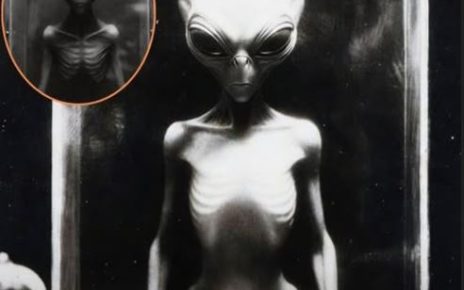
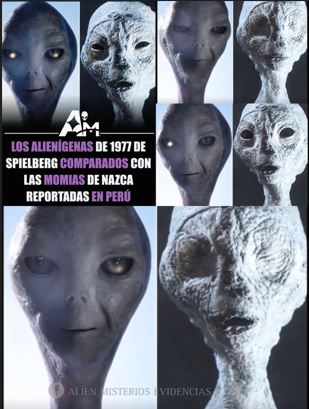
July 2026 — A viral collage comparing the iconic extraterrestrials portrayed in Steven Spielberg’s 1977 science-fiction classic Close Encounters of the Third Kind with the controversial “Nazca mummies” discovered in Peru has sparked renewed debate across social media. The side-by-side images, shared millions of times across platforms including X, Facebook, Reddit, and TikTok, have led many users to question whether Hollywood’s famous depiction of “Grey” aliens was inspired by real discoveries—or whether the similarities are simply coincidental.
The collage highlights what many viewers describe as striking resemblances between Spielberg’s cinematic aliens and the controversial mummified bodies presented by researchers in Peru over recent years. Shared physical characteristics include elongated skulls, slender necks, large almond-shaped eyes, small noses, and narrow mouths. Supporters of the comparison argue that the similarities are too precise to ignore, while skeptics maintain that the resemblance reflects a long-established fictional image of extraterrestrials rather than evidence of an unknown species.
The discussion has revived worldwide interest in the Nazca mummies, mysterious small bodies that first gained international attention after being introduced by private researchers who claimed they represented previously unknown biological specimens discovered near Peru’s Nazca region. Since their public unveiling, the remains have generated intense controversy within both scientific and UFO communities.
Several independent research groups have conducted examinations using CT scans, X-ray imaging, and DNA analysis. While some investigators have argued that the bodies display unusual anatomical features deserving further study, many archaeologists, anthropologists, and forensic specialists have reached different conclusions. Numerous experts contend that several of the specimens are likely composites assembled from modified human and animal remains rather than evidence of extraterrestrial beings.
Peruvian cultural authorities have repeatedly emphasized that extraordinary archaeological claims require careful scientific verification and have warned against drawing conclusions before peer-reviewed research is completed. They also continue to investigate the origins of several controversial specimens to determine whether they involve illegally modified archaeological remains.
The renewed attention surrounding the viral comparison has also prompted discussion about the origins of the “Grey alien” image in popular culture. Film historians note that Spielberg’s Close Encounters of the Third Kind premiered in 1977 and helped establish the now-familiar visual appearance of extraterrestrials in modern entertainment. However, descriptions of large-headed, dark-eyed humanoid beings existed long before the film, appearing in UFO literature, alleged encounter reports, and science-fiction artwork throughout the 1950s and 1960s.
As a result, researchers caution that visual similarities alone cannot establish any historical connection between the movie’s alien design and the Nazca specimens. The resemblance may instead reflect a cultural image that had already become associated with extraterrestrial life decades before the Peruvian discoveries were publicly announced.
Digital media analysts have also urged viewers to approach viral comparison images carefully. Side-by-side collages can emphasize similarities while minimizing important differences, making unrelated subjects appear more closely connected than they actually are. In today’s online environment, visually compelling comparisons often spread rapidly even when they lack supporting historical or scientific evidence.
Scientists involved in the search for extraterrestrial life stress that there is currently no verified evidence linking the Nazca mummies to alien civilizations. Likewise, no peer-reviewed scientific study has concluded that the remains represent non-human intelligent beings. While investigations into the specimens continue, the broader scientific community remains cautious, emphasizing the need for transparent research methods, reproducible testing, and independent verification.
The viral collage has nevertheless succeeded in reigniting public fascination with one of humanity’s oldest questions: Could intelligent life exist beyond Earth? Advances in astronomy over the past two decades have revealed thousands of planets orbiting distant stars, many of them located within regions where liquid water—and potentially life—could exist. Yet despite this growing evidence that habitable worlds may be common throughout the galaxy, scientists have not confirmed the existence of extraterrestrial organisms, much less visitors to Earth.
For now, the comparison between Spielberg’s fictional aliens and the Nazca mummies remains an intriguing visual observation rather than evidence of a hidden connection. Historians, archaeologists, and biologists continue to study the available evidence, while researchers emphasize that extraordinary claims require extraordinary proof.
Whether the resemblance ultimately proves to be coincidence, artistic influence, or something that inspires further investigation, the debate underscores humanity’s enduring fascination with the possibility that we are not alone in the universe. Until rigorous scientific research provides conclusive answers, the similarities highlighted in the viral images remain a topic of speculation rather than established fact.