Viral Claim of a 2,000-Mile-Long UFO Near Saturn Sparks Global Speculation, but Experts Urge Caution
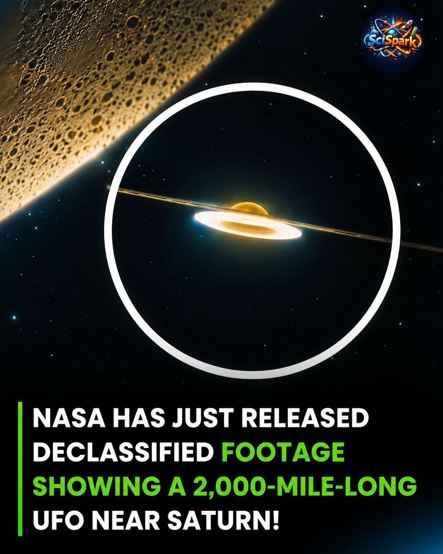
WASHINGTON, D.C. — July 2026 — A striking image claiming that NASA has released declassified footage showing a 2,000-mile-long unidentified object near Saturn has gone viral across social media, reigniting public fascination with extraterrestrial life and unexplained phenomena in deep space. The image, which depicts a glowing saucer-shaped object apparently hovering near Saturn’s iconic rings, has attracted millions of views and inspired countless discussions among UFO enthusiasts, amateur astronomers, and space science followers. However, experts emphasize that there is no publicly verified evidence that NASA has released footage confirming the existence of such an enormous object.
The viral post alleges that recently declassified material reveals an unidentified craft measuring approximately 2,000 miles (3,200 kilometers) in length orbiting near Saturn. If true, an object of that size would rank among the largest artificial structures ever imagined, exceeding the diameter of Earth’s Moon and rivaling some of the largest natural celestial bodies found throughout the Solar System.
The extraordinary nature of the claim has prompted widespread online debate. Some users suggest the object could represent an advanced extraterrestrial spacecraft operating within Saturn’s complex ring system, while others speculate it may be a massive space station constructed by an unknown civilization. More skeptical observers believe the image is likely digital artwork or an artistic interpretation inspired by ongoing public interest in unidentified aerial phenomena.
Astronomers point out that Saturn is one of the most thoroughly studied planets in the Solar System. Over the past several decades, numerous space missions—including NASA’s historic Cassini spacecraft, which orbited Saturn from 2004 to 2017—have returned hundreds of thousands of high-resolution images and an enormous quantity of scientific data. These missions carefully mapped Saturn’s atmosphere, rings, and more than 140 known moons with unprecedented detail.
Scientists note that an object measuring thousands of miles across would almost certainly have been detected long before now. Such a structure would significantly affect nearby gravitational fields, cast measurable shadows, and appear prominently in observations collected by spacecraft and Earth-based telescopes alike. To date, no peer-reviewed scientific study has reported the discovery of an artificial object matching the description presented in the viral image.
The illustration itself bears many characteristics commonly associated with digital concept art. The glowing saucer appears perfectly illuminated against a dramatic space backdrop, while the composition emphasizes visual impact rather than scientific realism. Image analysts suggest that the graphic was likely created to capture attention on social media rather than document an authentic astronomical observation.
Nevertheless, the image has revived broader conversations about the search for extraterrestrial intelligence. Researchers involved in the Search for Extraterrestrial Intelligence (SETI) continue using powerful radio telescopes and advanced signal-processing techniques to scan the cosmos for potential evidence of technologically advanced civilizations. Meanwhile, astronomers have identified more than 5,000 confirmed exoplanets, many of which orbit within regions where liquid water—and potentially life—could exist.
Despite these remarkable discoveries, scientists emphasize that no verified observation has demonstrated the existence of intelligent extraterrestrial visitors within our Solar System. The search for life beyond Earth remains an active scientific endeavor grounded in observation, experimentation, and peer-reviewed research rather than sensational headlines.
NASA regularly releases vast quantities of scientific imagery collected by its missions, including photographs from the Hubble Space Telescope, the James Webb Space Telescope, Mars rovers, and planetary probes. Much of this material is publicly accessible and has inspired countless scientific discoveries as well as artistic interpretations. However, NASA has not announced the discovery or declassification of footage showing a gigantic UFO near Saturn.
Experts in digital media also warn that advances in artificial intelligence and image-generation software have made it increasingly easy to create realistic-looking depictions of spacecraft, alien worlds, and cosmic phenomena. Without supporting metadata, mission documentation, observational data, or independent confirmation from multiple scientific institutions, dramatic images should be treated as illustrations rather than evidence.
Planetary scientists explain that Saturn itself remains one of the most fascinating worlds in the Solar System without requiring extraordinary claims. Its magnificent ring system consists of billions of ice and rock particles, while several of its moons—including Enceladus and Titan—are among the most promising locations in the search for microbial life. Enceladus ejects towering plumes of water vapor from beneath its icy crust, and Titan possesses lakes and rivers composed of liquid methane, making both moons high priorities for future exploration.
The popularity of the viral image demonstrates the enduring public fascination with mysteries beyond Earth. Humanity has always looked toward the night sky wondering whether intelligent life exists elsewhere in the universe, and each new space mission brings fresh opportunities for discovery. Yet scientists consistently stress that remarkable claims demand equally remarkable evidence.
For now, the alleged 2,000-mile-long UFO near Saturn remains part of an internet narrative rather than an established scientific finding. While NASA continues exploring the outer Solar System and expanding humanity’s understanding of the cosmos, there is no publicly verified evidence that the agency has discovered—or declassified footage of—a colossal alien spacecraft orbiting Saturn.
As telescope technology advances and future missions venture deeper into space, astronomers remain optimistic that new discoveries will continue to reshape our understanding of the universe. Until then, experts encourage curiosity balanced with critical thinking, reminding the public that the greatest scientific breakthroughs are built not on speculation, but on careful observation, transparent evidence, and rigorous investigation.