Trump Announces New UAP Governance Board as Avi Loeb Urges Scientific Approach to UFO Mystery
WASHINGTON, D.C. — A new wave of debate surrounding unidentified anomalous phenomena (UAPs), commonly known as UFOs, has erupted after claims circulated online suggesting that former President Donald Trump intends to establish a dedicated UAP Governance Board with Harvard astrophysicist Avi Loeb serving as a scientific adviser. While no official government announcement has confirmed such a board, the discussion has reignited public interest in one of the most controversial subjects in modern science and national security.
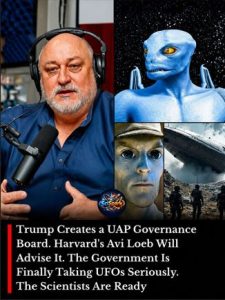
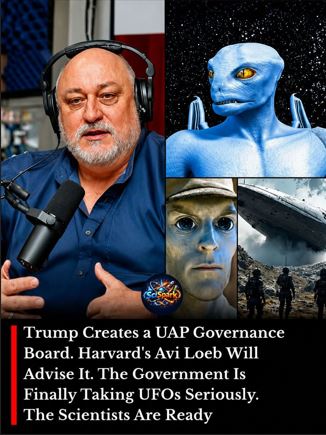
The viral image accompanying the claim features Avi Loeb alongside artistic depictions of extraterrestrial beings and advanced spacecraft, accompanied by the headline that “the government is finally taking UFOs seriously.” Within hours of appearing across social media platforms, the image attracted thousands of comments from supporters, skeptics, and researchers alike.
Although the existence of a new governance board remains unverified, experts say the broader conversation reflects how dramatically attitudes toward UAP investigations have changed over the past decade.
Only a few years ago, reports of unidentified aerial objects were often dismissed as conspiracy theories. Today, however, governments, military organizations, and scientific institutions openly acknowledge that unexplained sightings deserve careful analysis. The U.S. Department of Defense has established offices dedicated to investigating unusual aerial encounters, while Congress has held multiple hearings examining military pilot reports and classified intelligence.
Harvard astronomer Avi Loeb has become one of the most recognizable scientific voices advocating for a rigorous investigation of unexplained phenomena. Rather than assuming extraordinary explanations, Loeb argues that every unusual observation should be examined through the scientific method.
“Our job as scientists is not to dismiss evidence,” Loeb has said during numerous public appearances. “It is to collect data and follow where it leads.”
Loeb is best known for proposing that the interstellar object ‘Oumuamua, discovered in 2017, displayed characteristics unusual enough to justify considering unconventional possibilities. Although most astronomers believe the object was a naturally occurring body, Loeb’s willingness to explore alternative hypotheses has made him a prominent figure in discussions surrounding extraterrestrial intelligence.
His Galileo Project, launched in 2021, seeks to gather high-quality observational data using sophisticated telescopes, cameras, and sensors capable of detecting anomalous aerial objects. The project’s mission is to replace speculation with measurable evidence.
Supporters of the rumored UAP Governance Board argue that such an organization could coordinate military reporting, civilian observations, satellite analysis, and academic research under a unified framework. They believe improved transparency would help distinguish ordinary aircraft, atmospheric phenomena, experimental technology, and genuinely unexplained incidents.
National security analysts have also emphasized that unidentified objects deserve investigation regardless of whether they have extraterrestrial origins. Unknown aircraft operating near sensitive military installations could represent foreign surveillance technologies, classified domestic programs, or sensor anomalies that require better understanding.
Critics, however, caution against accepting sensational claims without official confirmation. Several viral posts over the past year have incorrectly attributed statements to government officials or exaggerated ongoing investigations. Fact-checkers continue to remind the public that social media images often combine authentic photographs with speculative captions designed to generate engagement.
Scientists likewise stress that extraordinary claims require extraordinary evidence.
Despite thousands of reported UAP sightings worldwide, no publicly available evidence has conclusively demonstrated that any observed object originated from an extraterrestrial civilization. Most investigated cases eventually receive conventional explanations, including balloons, drones, atmospheric effects, astronomical objects, or imaging artifacts.
Still, a small percentage of reports remain unresolved due to insufficient data rather than proof of alien technology.
That uncertainty continues to fuel public fascination.
Online communities dedicated to UFO research have grown substantially, with amateur astronomers, pilots, engineers, and data analysts collaborating to review videos and radar information. Advances in smartphone cameras, artificial intelligence, and satellite imaging have made it easier than ever to document unusual events, although they have also increased the spread of manipulated images and AI-generated content.
For many observers, the larger issue is no longer whether every UFO represents alien visitors. Instead, the focus has shifted toward improving data collection, increasing transparency, and applying scientific standards to a topic that was once considered taboo.
If a future administration were to create a specialized UAP advisory board, experts suggest its success would depend on openness, independent oversight, and collaboration between defense agencies and civilian researchers. Such an organization would likely prioritize standardized reporting procedures, sensor calibration, and peer-reviewed analysis rather than speculation.
Whether the viral claim ultimately proves true or not, it highlights a remarkable shift in public discourse. Discussions once confined to science fiction conventions now regularly appear in congressional hearings, university laboratories, and mainstream news coverage.
For now, there is no verified evidence that Donald Trump has officially announced a UAP Governance Board or that Avi Loeb has accepted a formal advisory role in such an organization. Nevertheless, interest in unidentified aerial phenomena continues to expand, driven by ongoing government investigations, scientific curiosity, and a growing demand for reliable information.
As researchers continue collecting higher-quality evidence and governments gradually release additional data, one question remains at the center of the global conversation: are these unexplained sightings simply misunderstood natural or human-made phenomena, or do they point toward discoveries that could fundamentally reshape humanity’s understanding of the universe?