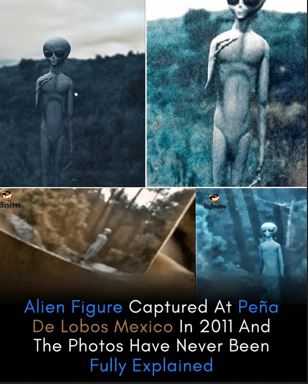
Alleged 2011 Alien Figure Photographs from Peña de Lobos Continue to Fuel Debate Despite Ongoing Skepticism
A series of mysterious photographs allegedly taken near Peña de Lobos, Mexico, in 2011 has resurfaced online, reigniting one of the internet’s longest-running debates over alleged extraterrestrial encounters. The images, which appear to show a thin humanoid figure standing among trees and brush in a remote natural area, have once again spread across social media, where believers argue they represent compelling visual evidence of an alien being, while skeptics maintain the photographs have likely been misunderstood or manipulated. More than a decade after they first appeared, the images remain controversial, with no definitive conclusion regarding their authenticity.
According to claims accompanying the photographs, the incident occurred near Peña de Lobos, a mountainous region known for its rugged landscape and dense forests. The individual who reportedly captured the images allegedly noticed an unusual figure standing motionless among the trees before taking several photographs from different angles. The figure appears unusually slender, with elongated limbs, a narrow torso, and an oversized head featuring large, dark eyes—characteristics commonly associated with the classic “Grey” alien frequently described in UFO folklore.
The photographs quickly gained attention after being shared on paranormal websites and discussion forums. Within weeks, they had spread internationally, attracting interest from UFO researchers, amateur investigators, photographers, and digital imaging specialists.
Supporters of the images argue that the figure appears consistent across multiple photographs, suggesting that it was physically present rather than added digitally afterward. They also note that the lighting and shadows seem reasonably consistent with the surrounding environment, leading some enthusiasts to believe the images deserve serious investigation.
Several UFO researchers have described the Peña de Lobos photographs as among the more intriguing alleged alien images to emerge during the early era of widespread digital photography. They point out that the subject appears in different positions throughout the sequence, which they argue would require significant effort if the images were fabricated.
However, experts specializing in photography and visual analysis remain unconvinced.
Image analysts note that the relatively low resolution of the photographs makes detailed examination difficult. Compression artifacts, motion blur, lighting conditions, and distance from the subject all reduce the amount of reliable visual information available for analysis.
Some investigators believe the figure could simply be a person wearing a costume positioned at a considerable distance from the camera. Others suggest that the unusual proportions may result from perspective distortion, shadows, or digital editing.
Professional photographers have also emphasized that telephoto lenses can compress distance and alter perceived body proportions, making ordinary subjects appear unusually tall or thin. In natural environments, tree trunks, uneven terrain, and changing light conditions can further contribute to optical illusions that exaggerate unusual features.
Digital forensics experts have repeatedly pointed out that without access to the original image files—including full-resolution photographs and camera metadata—it is impossible to determine conclusively whether the pictures have been altered. Most versions currently circulating online have been heavily compressed after years of reposting across websites and social media platforms.
The renewed popularity of the photographs comes at a time when public interest in unidentified anomalous phenomena continues to grow. Government investigations into unexplained aerial sightings have encouraged renewed discussion of historical UFO cases, prompting internet users to revisit older photographs and videos that were once largely forgotten.
Nevertheless, scientists caution against treating dramatic images as proof of extraordinary claims.
Researchers emphasize that photographs alone rarely provide sufficient evidence to establish the existence of extraterrestrial life. Authentic scientific investigation typically requires multiple independent witnesses, physical evidence, verified locations, original source materials, and reproducible documentation before extraordinary conclusions can be reached.
Psychologists also explain that people naturally attempt to interpret ambiguous images in meaningful ways. When viewers are already familiar with the popular image of the “Grey” alien from decades of books, films, and television, they may be more likely to interpret unclear figures as extraterrestrial beings rather than ordinary objects or people.
Online investigators have attempted to determine the exact location where the photographs were allegedly taken by comparing vegetation, terrain, and landscape features with satellite imagery of Peña de Lobos. Despite years of discussion, these efforts have not produced definitive confirmation of the site or the circumstances surrounding the images.
Some researchers have also questioned why no additional witnesses, photographs, or video recordings have surfaced from the same location if such an extraordinary encounter truly occurred. Others argue that isolated incidents in remote wilderness areas could easily go undocumented.
Today, the Peña de Lobos photographs remain one of the many unresolved cases frequently cited within UFO communities. For believers, they represent a fascinating glimpse into the possibility of extraterrestrial visitation. For skeptics, they illustrate how ambiguous photographs can quickly evolve into enduring internet legends without sufficient supporting evidence.
At present, there is no verified scientific or governmental evidence confirming that the figure shown in the photographs is an extraterrestrial being. Likewise, no conclusive analysis has proven that the images are an intentional hoax. Until original files, additional documentation, or independently verifiable evidence become available, the Peña de Lobos photographs remain an intriguing but unconfirmed mystery—one that continues to inspire curiosity while reminding both investigators and the public that extraordinary claims must be supported by extraordinary evidence.