Mysterious “Alien Family” Image Sparks Global Debate as Social Media Users Question Its Origin
A striking image appearing to show what many online users have described as an “alien family” has gone viral across multiple social media platforms, reigniting long-standing debates about extraterrestrial life, artificial intelligence, and the growing challenge of distinguishing authentic imagery from sophisticated digital creations.

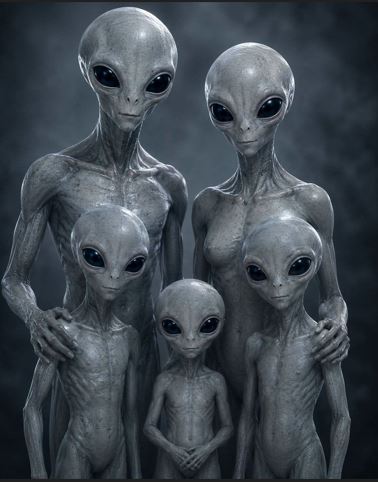
The photograph, which depicts five gray humanoid beings standing closely together in what resembles a formal family portrait, has accumulated millions of views within days. The figures share many of the characteristics commonly associated with the popular “Gray Alien” archetype, including elongated heads, oversized black eyes, slender bodies, and smooth gray skin. The image has been widely circulated alongside claims that it represents a leaked government photograph, an extraterrestrial family, or even evidence recovered from classified research programs.
Despite the sensational claims accompanying the image, no verifiable source has emerged to confirm where it originated or whether it depicts any real event.
The image first gained traction after being reposted by several UFO-focused communities, where users suggested it could represent one of the clearest visual depictions of non-human intelligence ever released online. Within hours, discussion spread across Facebook, X, Reddit, TikTok, and YouTube, with thousands of users offering competing theories about its authenticity.
Some viewers argued that the beings appear remarkably lifelike, pointing to realistic skin textures, subtle facial asymmetry, and natural-looking lighting. Others suggested the composition resembles a carefully staged portrait rather than a spontaneous photograph, leading many digital artists to speculate that advanced AI image-generation technology may have been involved.
Experts in computer-generated imagery note that modern AI tools have become capable of producing photorealistic scenes that can be difficult for the average viewer to distinguish from genuine photographs. High-resolution textures, realistic reflections, and convincing facial details have dramatically improved in recent years, making visual verification increasingly challenging without access to the original image files or metadata.
Adding to the intrigue is the emotional composition of the image itself. Unlike many fictional alien illustrations that portray extraterrestrials as threatening or mysterious, the five figures appear calm and composed. Two taller individuals stand protectively behind three smaller figures, leading many online commentators to describe the scene as resembling a family portrait rather than an encounter.
Supporters of the extraterrestrial hypothesis argue that if intelligent life exists elsewhere in the universe, it would be reasonable to expect family structures or social groups rather than isolated individuals. Some UFO enthusiasts suggested the image offers a rare glimpse into what an alien civilization might actually look like if captured in a peaceful setting.
Skeptics, however, caution against drawing conclusions based solely on appearance. They emphasize that the image lacks supporting evidence such as the original camera source, location, photographer identification, or independent verification. Without those details, they argue, the photograph cannot be treated as evidence of extraterrestrial life.
The debate arrives during a period of renewed public interest in unidentified anomalous phenomena. Over the past several years, governments, military organizations, and scientific institutions have acknowledged that certain aerial observations remain unexplained after investigation. While these cases have encouraged greater transparency regarding unidentified objects, officials have repeatedly stressed that “unidentified” does not automatically mean extraterrestrial.
Researchers also point out that many viral UFO and alien images gain popularity because they tap into decades of cultural familiarity. The classic Gray Alien design has appeared in books, films, television series, documentaries, and reported eyewitness accounts since the 1960s, making it one of the most recognizable fictional—or allegedly real—depictions of extraterrestrial beings in popular culture.
Psychologists studying online behavior note that images involving aliens often spread rapidly because they evoke curiosity, fear, and wonder simultaneously. Social media algorithms further amplify emotionally engaging content, allowing dramatic claims to reach millions of viewers before careful analysis can take place.
Digital forensic analysts recommend several steps before accepting extraordinary images as authentic. They advise checking for the original upload, examining metadata when available, searching for earlier versions of the image, and comparing it against known AI-generated artwork. Reverse image searches and independent expert analysis can also help determine whether an image has been altered or artificially created.
As of now, no government agency, scientific institution, or recognized research organization has publicly authenticated the viral “alien family” photograph. Likewise, no credible evidence has emerged connecting the image to any official investigation, classified program, or documented extraterrestrial encounter.
Even so, the picture continues to fuel discussion across the internet. For believers, it represents another intriguing possibility that humanity may not be alone in the universe. For skeptics, it serves as a reminder that extraordinary visual content requires equally extraordinary evidence. For everyone else, it highlights how rapidly technology is transforming our ability to create—and question—what we see.
Until additional information becomes available, the viral image remains exactly what it is today: an eye-catching mystery that has captivated millions, inspired countless theories, and once again blurred the line between science fiction, digital artistry, and humanity’s enduring fascination with the possibility of life beyond Earth.