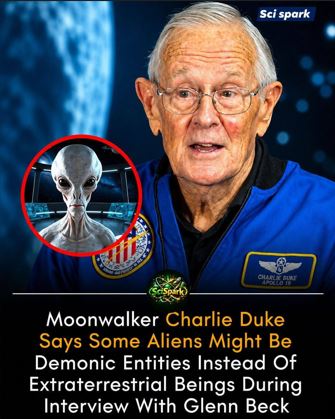
Moonwalker Charlie Duke’s Comments on Alien Life Reignite Debate Over the Nature of UFO Encounters
Public interest in unidentified aerial phenomena (UAPs) has surged once again following renewed attention to comments made by Apollo 16 astronaut Charlie Duke regarding the possibility of extraterrestrial life and the spiritual interpretation of some reported encounters. Viral social media posts have circulated alongside dramatic images claiming that Duke suggested certain alleged alien encounters may not involve visitors from distant planets, but could instead represent spiritual or even demonic entities. While the claims have sparked intense online discussion, the remarks have also reignited a broader debate over how unexplained phenomena should be interpreted.
Charlie Duke, one of only twelve people to have walked on the Moon, remains one of NASA’s most respected former astronauts. Having flown aboard Apollo 16 in 1972, Duke spent more than 71 hours exploring the lunar surface before safely returning to Earth. His distinguished military and spaceflight career has made his opinions particularly influential whenever discussions about extraterrestrial life emerge.
The latest wave of attention began after excerpts from an interview circulated across social media platforms, accompanied by headlines suggesting that Duke had expressed skepticism toward the popular assumption that unidentified aerial phenomena automatically indicate extraterrestrial civilizations. Instead, according to widely shared posts, Duke reportedly stated that some extraordinary experiences described by witnesses could have spiritual explanations rather than scientific ones.
The comments quickly spread throughout UFO communities, attracting millions of views and generating thousands of discussions. Some users interpreted the statements as evidence that individuals with experience inside America’s space program possess knowledge that has not yet been fully disclosed to the public. Others argued that the interview reflected Duke’s personal religious beliefs rather than insider knowledge about unidentified phenomena.
Supporters of the spiritual interpretation point out that reports involving mysterious lights, unexplained beings, and unusual aerial objects have appeared throughout recorded history, often long before modern aviation or space exploration existed. Ancient civilizations frequently described celestial events through religious language, interpreting extraordinary sightings as encounters with angels, divine messengers, or supernatural forces. Modern UFO researchers note that many contemporary reports also include unusual psychological experiences, leading some investigators to consider whether certain encounters extend beyond conventional physical explanations.
However, scientists caution that unexplained experiences should not immediately be attributed to either extraterrestrial visitors or supernatural beings. Researchers emphasize that extraordinary claims require independently verifiable evidence, including physical data, multiple reliable witnesses, radar confirmation, or scientifically testable observations. Without such evidence, interpretations remain speculative regardless of whether they involve alien civilizations or spiritual entities.
The discussion also highlights the growing complexity surrounding unidentified aerial phenomena in recent years. Governments around the world, including the United States, have acknowledged investigating reports submitted by military pilots and civilian observers. Several official reports have concluded that while some incidents remain unexplained, there is currently no publicly available evidence demonstrating that these objects originate from extraterrestrial civilizations.
NASA has likewise increased its scientific interest in unidentified aerial phenomena, emphasizing that careful investigation is necessary whenever credible reports emerge. Rather than beginning with assumptions, researchers advocate collecting high-quality sensor data, photographic evidence, witness testimony, and environmental information before attempting to determine the nature of any unusual observation.
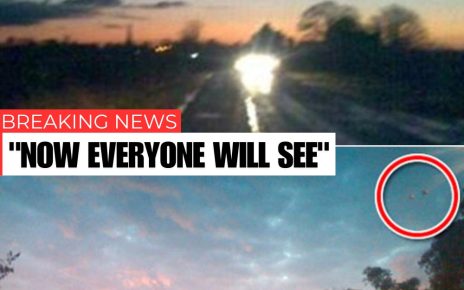
Meanwhile, digital technology has dramatically changed the landscape of UFO research. Artificial intelligence software now allows creators to generate highly realistic images and videos within minutes, making it increasingly difficult for the public to distinguish authentic documentation from fictional artwork. Digital forensic analysts therefore encourage viewers to examine the original source of viral material before accepting extraordinary claims presented alongside dramatic images or headlines.
The renewed focus on Duke’s comments has also sparked discussions within religious communities. Some theologians note that Christianity, along with several other faith traditions, has long recognized the possibility that certain unexplained experiences may involve spiritual deception rather than physical visitors from another world. Others argue that if intelligent extraterrestrial civilizations exist elsewhere in the universe, their existence would not necessarily conflict with religious belief. These differing perspectives illustrate how the UFO question often extends beyond science into philosophy, theology, and human culture.
Astronomers continue searching for signs of life beyond Earth through increasingly sophisticated telescopes and planetary exploration missions. Thousands of exoplanets have now been discovered orbiting distant stars, with several located within regions where liquid water—and potentially life—could exist. Many scientists consider the existence of microbial or even intelligent extraterrestrial life somewhere in the universe statistically possible. Nevertheless, no publicly verified evidence has confirmed that nonhuman civilizations have visited Earth.
As the online debate continues, experts from multiple disciplines agree on one important principle: maintaining a distinction between evidence and interpretation. Whether a mysterious sighting is viewed through scientific investigation, religious belief, or philosophical inquiry, conclusions should remain proportional to the available evidence.
Charlie Duke’s reported remarks have therefore become less about proving or disproving alien life and more about encouraging thoughtful discussion regarding the many ways unexplained phenomena can be understood. His comments remind audiences that even among highly accomplished individuals, perspectives on UFOs vary considerably and are often shaped by personal experiences, scientific reasoning, and deeply held beliefs.
For now, questions surrounding unidentified aerial phenomena remain unresolved. While governments continue investigating unexplained reports and scientists search for evidence of life beyond Earth, no definitive proof has established that UFOs represent extraterrestrial spacecraft, spiritual manifestations, or any single explanation. Until stronger evidence emerges, the mystery continues to inspire curiosity, debate, and ongoing research, making it one of the most fascinating subjects at the intersection of science, history, and human imagination.