Viral “Moon Is a Machine” Theory Resurfaces, Sparking Debate Between Conspiracy Believers and Scientists
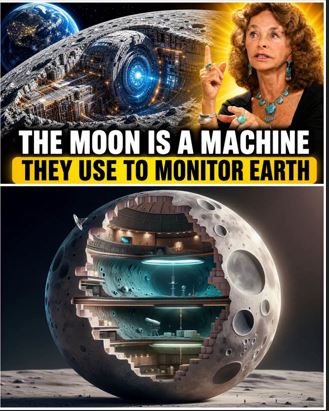
A dramatic image claiming that the Moon is an enormous artificial machine used to monitor Earth has gone viral once again, reigniting one of the internet’s longest-running conspiracy theories. Shared widely across social media platforms, the artwork depicts a cross-section of the Moon revealing a futuristic interior filled with massive chambers, advanced technology, and what appears to be a giant central energy core. Accompanied by the bold headline, “The Moon Is a Machine They Use to Monitor Earth,” the image has fueled renewed discussion among conspiracy theorists, UFO enthusiasts, and curious observers alike.
The claim has attracted millions of views online, with users debating whether humanity’s closest celestial neighbor could be far more than a naturally formed satellite. While some viewers speculate that the illustration hints at hidden truths allegedly concealed for decades, astronomers and planetary scientists emphasize that there is currently no credible scientific evidence supporting the idea that the Moon is artificial or inhabited by advanced civilizations.
According to numerous posts circulating online, advocates of the theory argue that certain unusual characteristics of the Moon deserve closer examination. They often point to its relatively large size compared to Earth, its nearly circular orbit, and the fact that the same side of the Moon always faces our planet due to tidal locking. Some also reference historical accounts from the Apollo era, claiming that seismic experiments suggested the Moon “rang like a bell” after discarded spacecraft components impacted its surface.
These observations have frequently been presented as evidence that the Moon may possess an unusual internal structure.
However, planetary scientists explain that these claims have well-established scientific explanations.
The famous “ringing” description originated from Apollo seismic experiments conducted between 1969 and 1977. Researchers found that vibrations traveled efficiently through the Moon because of its dry, fractured rocky interior, which lacks liquid water to dampen seismic waves. While the phenomenon appeared unusual compared to Earth’s geology, scientists concluded that it was entirely consistent with the Moon’s composition rather than evidence of a hollow or artificial structure.
Similarly, the Moon’s tidal locking is not considered mysterious by astronomers. Many moons throughout the Solar System exhibit the same behavior after billions of years of gravitational interaction with their parent planets. This process is well understood through celestial mechanics and does not require the existence of artificial technology.
Despite these scientific explanations, the “artificial Moon” hypothesis has remained popular for decades.
Some versions of the theory suggest that the Moon functions as a gigantic observation platform built by an ancient extraterrestrial civilization. Others claim it serves as a base for monitoring human civilization or even as a spacecraft intentionally placed in Earth’s orbit thousands or millions of years ago.
No physical evidence has ever been presented to support these extraordinary claims.
The image currently circulating online appears to be a digital illustration rather than an actual scientific rendering. Experts in computer graphics note that advances in artificial intelligence and digital artwork have made it increasingly easy to create realistic images depicting fictional concepts. While visually impressive, such illustrations should not be mistaken for documentary evidence.
NASA and numerous international space agencies have studied the Moon extensively through orbiters, robotic landers, and crewed Apollo missions. These missions have returned hundreds of kilograms of lunar rocks and soil, providing scientists with detailed information about the Moon’s composition, age, and geological history.
Current scientific evidence indicates that the Moon formed approximately 4.5 billion years ago, most likely after a massive collision between the early Earth and a Mars-sized protoplanet often referred to as Theia. Material ejected during that impact gradually coalesced into the Moon observed today. This giant-impact hypothesis remains the leading scientific explanation because it successfully accounts for many observed characteristics of the Earth-Moon system.
Even so, conspiracy theories surrounding the Moon continue to attract public attention.
Supporters argue that governments and space agencies may be withholding important discoveries from the public, while skeptics counter that extraordinary allegations require independently verifiable evidence rather than speculation or anonymous testimony.
Science communicators note that viral images often combine authentic scientific facts with imaginative fictional concepts, making it difficult for casual viewers to distinguish established research from creative storytelling. As a result, striking graphics frequently spread far more rapidly than detailed scientific explanations.
Astronomers emphasize that many mysteries about the Moon remain under active investigation. Researchers continue studying permanently shadowed craters near the lunar poles, ancient volcanic regions, subsurface lava tubes, and the possibility of water ice deposits that could support future human exploration.
These legitimate scientific questions, however, differ significantly from claims that the Moon is an artificial machine.
As governments and private space companies prepare new lunar missions over the coming decade, interest in Earth’s natural satellite is expected to grow even further. Planned expeditions aim to establish long-term research stations, collect new geological samples, and better understand the Moon’s formation and its role in the history of the Solar System.
For now, the viral image serves as another example of how extraordinary claims can capture global attention in the age of social media. While the concept of an artificial Moon continues to inspire science fiction, documentaries, and online debate, no verified scientific evidence currently supports the assertion that the Moon is a gigantic machine monitoring Earth. Until such evidence emerges through rigorous investigation and independent verification, researchers encourage the public to appreciate the distinction between imaginative speculation and conclusions supported by decades of astronomical observation and planetary science.