Viral “Alien Moon Base” Images Ignite Debate as Speculation About Hidden Lunar Structures Returns
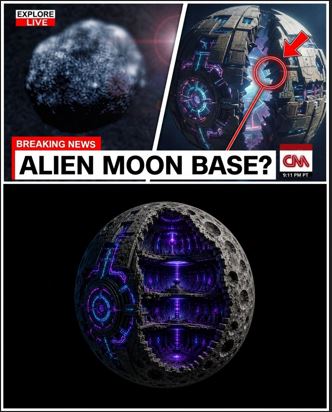
A dramatic series of images claiming to reveal a massive artificial structure hidden inside the Moon has once again captured the attention of social media users around the world. Shared under headlines such as “Alien Moon Base?” and accompanied by digitally enhanced illustrations of a partially hollow Moon filled with glowing technological components, the viral post has reignited one of the oldest and most controversial theories in UFO lore—that Earth’s natural satellite may conceal an advanced extraterrestrial installation beneath its surface.
The images, which have been viewed millions of times across multiple online platforms, depict what appears to be a metallic framework embedded inside the Moon, illuminated by bright blue and purple energy systems. One illustration presents the lunar interior as a gigantic technological complex complete with circular chambers, energy conduits, and what some viewers describe as reactor-like structures. Another image highlights a mysterious object approaching the Moon, suggesting it may be connected to the alleged hidden installation.
Supporters of the theory argue that these visuals resemble long-standing claims made by UFO researchers who believe unusual anomalies observed on the lunar surface cannot be explained through conventional geology alone. They point to decades of reports describing strange lights, temporary glowing phenomena, geometric formations, and unexplained shadows photographed during various lunar missions.
The idea of an artificial Moon or a hidden lunar base is far from new. It has appeared repeatedly in books, documentaries, and science fiction for more than half a century. Some researchers have speculated that if an advanced extraterrestrial civilization wished to observe Earth without attracting attention, establishing a monitoring station beneath the Moon’s heavily cratered surface would provide a strategically ideal location.
According to proponents of the hypothesis, the Moon offers several advantages as a possible observation platform. Positioned approximately 384,000 kilometers from Earth, it provides a stable vantage point while naturally shielding any underground structures from direct observation. They also note that lava tubes—vast underground tunnels formed by ancient volcanic activity—have been confirmed to exist on the Moon and could theoretically provide enormous protected spaces beneath the surface.
Some online discussions reference comments allegedly made by former astronauts, engineers, or military personnel who claimed that unusual objects had been observed during lunar missions. However, many of these stories remain anecdotal and have not been supported by publicly available mission data or official documentation.
Planetary scientists emphasize that decades of exploration have dramatically improved humanity’s understanding of the Moon. Orbital spacecraft from NASA, the European Space Agency, China, India, Japan, and other nations have mapped nearly every portion of the lunar surface in remarkable detail. These missions have revealed countless geological features, including impact craters, volcanic plains, fault scarps, and underground lava tubes, but none have produced verified evidence of artificial extraterrestrial structures.
Experts also caution that many so-called “anomalies” originate from the human tendency to recognize familiar patterns in random landscapes. This psychological phenomenon, known as pareidolia, can cause natural rock formations, shadows, or lighting effects to resemble buildings, machinery, or other recognizable objects when viewed from certain angles.
The viral images themselves appear highly stylized, leading many digital imaging specialists to conclude they are artistic visualizations rather than authentic lunar photographs. Advances in computer graphics and artificial intelligence have enabled creators to produce incredibly realistic depictions of hypothetical environments, often making it difficult for casual viewers to distinguish between conceptual artwork and genuine scientific imagery.
Despite the lack of supporting evidence, interest in the hidden Moon theory has grown alongside renewed international efforts to return humans to the lunar surface. Multiple space agencies are planning long-term exploration programs that aim to establish research stations near the Moon’s south pole, where permanently shadowed craters may contain significant deposits of water ice. These future missions are expected to provide unprecedented opportunities to study the Moon’s geology in greater detail than ever before.
Some enthusiasts argue that expanded exploration could eventually settle long-standing questions regarding unexplained lunar observations. Scientists, however, maintain that the primary objectives of these missions involve geology, resource utilization, astronomy, and preparation for future deep-space exploration rather than investigations into extraterrestrial civilizations.
Historians note that the concept of a hidden Moon base has remained popular largely because it combines several enduring mysteries into a single compelling narrative. The Moon has fascinated humanity throughout recorded history, and its unexplored underground regions continue to inspire speculation. Combined with widespread public interest in unidentified aerial phenomena and the possibility of intelligent life elsewhere in the universe, stories involving secret lunar installations consistently attract enormous attention online.
The rapid spread of visually striking graphics also highlights the challenges posed by modern digital media. Artificial intelligence, advanced rendering software, and image-editing tools now allow creators to produce convincing fictional scenes that can circulate globally within hours. Without clear sourcing or contextual information, these images are frequently mistaken for genuine documentary evidence.
Astronomers stress that extraordinary claims require extraordinary evidence. While the existence of life elsewhere in the universe remains an active area of scientific investigation, no verified observations have demonstrated that extraterrestrial civilizations have constructed bases on or inside the Moon. Current lunar data collected over decades of robotic and human exploration continue to support the Moon’s natural geological origin.
For now, the viral “Alien Moon Base” images remain speculative illustrations that have fueled public imagination rather than confirmed discoveries. They serve as another reminder of humanity’s enduring fascination with the unknown and our desire to explore unanswered questions about the cosmos. As future lunar missions continue to expand scientific knowledge, researchers hope that careful observation, transparent data, and rigorous analysis—not sensational headlines—will ultimately determine whether any extraordinary secrets truly lie hidden beneath the Moon’s ancient surface.


