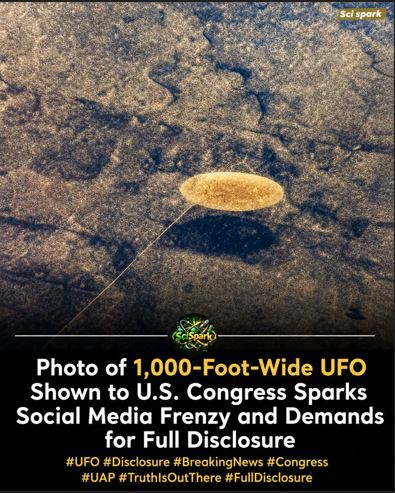
A photograph described online as showing a massive, disc-shaped unidentified flying object has sparked renewed debate over alleged UFO sightings, government transparency and the possibility that unexplained objects have been observed in restricted or remote areas. The image, which has circulated widely on social media, appears to show a large, oval or disc-like object hovering above a barren landscape. Text accompanying the photograph claims that the object is approximately 1,000 feet wide and that an image of it was presented to members of the U.S. Congress. Those claims, however, have not been independently established, and the origin and authenticity of the photograph remain unclear.
The image has nevertheless attracted significant attention because of the extraordinary scale attributed to the object. If an object of that size were genuinely present in the atmosphere, it would represent a remarkable observation. A craft hundreds of feet across would be considerably larger than most conventional aircraft and would raise immediate questions about its construction, propulsion system and ability to remain airborne. The photograph itself provides few reliable clues about distance or scale, making it difficult to determine the actual dimensions of the object from the image alone.
The photograph appears to show a smooth, flattened object with an unusual golden or bronze appearance. A thin line can be seen extending toward the object, although it is impossible from the photograph alone to determine whether this is physically connected to it, part of the surrounding environment or an artifact of the image. The background appears relatively featureless, which further complicates attempts to estimate the object’s distance and size. Without independent measurements, multiple camera angles or information about the location and conditions under which the photograph was taken, the claimed 1,000-foot measurement cannot be treated as established fact.
The reference to the U.S. Congress has added another layer of interest. In recent years, congressional hearings have brought increased public attention to unidentified anomalous phenomena, commonly known as UAPs. Government witnesses, military personnel and former officials have testified about unexplained observations, prompting lawmakers to demand greater transparency and improved systems for reporting and investigating unusual incidents. These discussions have helped move the subject of UAPs from the margins of popular culture into a more serious national-security and scientific conversation.
However, congressional interest in UAPs should not automatically be interpreted as confirmation that extraterrestrial spacecraft have been discovered. The U.S. government has acknowledged that military personnel sometimes encounter objects or phenomena they cannot immediately identify. An unidentified object can have many possible explanations, including aircraft, balloons, drones, atmospheric phenomena, sensor errors, optical effects or classified technology. Determining what something is requires evidence beyond a compelling photograph or an anonymous claim.
The photograph has also generated renewed demands for what supporters describe as “full disclosure.” On social media, users have called for authorities to release original photographs, radar information, satellite data and other documentation that could establish where and when the alleged object was recorded. Researchers emphasize that such evidence would be far more valuable than an edited or compressed image circulating online. Original files could potentially contain metadata, while multiple independent sensors could help determine whether an unusual object was actually present and how large it was.
Experts would also need to establish the circumstances surrounding the photograph. Perspective can dramatically distort perceived size. An object relatively close to a camera can appear enormous, while a much larger object at a greater distance can appear surprisingly small. Atmospheric haze, reflections, image compression and digital enhancement can further alter the appearance of unidentified objects. For this reason, investigators generally look for corroborating evidence rather than relying on visual impressions alone.
Despite these uncertainties, the photograph has become another example of how quickly UFO-related material can spread in the digital age. A striking image accompanied by a dramatic claim can reach millions of viewers before journalists, scientists or investigators have an opportunity to verify its origin. Once repeated across multiple platforms, an unverified statement can begin to appear authoritative simply because it has been widely shared.
For now, the alleged 1,000-foot UFO remains an intriguing but unverified claim. The photograph may eventually be explained through conventional analysis, or additional evidence could provide a clearer understanding of what was captured. Until independent documentation confirms the object’s size, location, provenance and nature, the most responsible conclusion is that the image raises questions rather than providing definitive answers. What is certain is that public interest in UAPs continues to grow, and each new photograph—whether genuine, misunderstood or digitally created—adds fuel to a much larger debate about what remains unexplained in the skies above us.