Euclid Telescope Just Captured These UNEXPLAINED Images!
A remarkable collection of deep-space images captured by the European Space Agency’s Euclid telescope is generating excitement among astronomers, with unfamiliar arcs, glowing rings, distorted galaxies, and previously unseen cosmic structures appearing across its enormous survey of the sky.

Launched in July 2023 and stationed approximately 1.5 million kilometers from Earth, Euclid was designed to investigate two of the greatest mysteries in modern science: dark matter and dark energy. Its mission is to observe billions of galaxies across more than one-third of the sky and build a three-dimensional map covering roughly 10 billion years of cosmic history. Some of its most intriguing images show distant galaxies stretched into luminous curves or arranged in apparently impossible circular patterns. Although these objects may look artificial, scientists say many are likely examples of gravitational lensing, a phenomenon in which the gravity of a massive foreground galaxy or galaxy cluster bends and magnifies light arriving from a more distant source. In rare cases, near-perfect alignment can produce a complete “Einstein ring,” making one galaxy appear as a glowing circle around another. Euclid’s early observations have already produced a catalog of 500 strong gravitational-lens candidates, almost all previously unknown, and researchers expect the mission to identify tens of thousands more. Yet not every feature can be immediately classified. Astronomers must distinguish genuine discoveries from image-processing artifacts, cosmic-ray strikes, unusual alignments, and natural objects seen from unfamiliar angles. This is why certain images may initially be described as unexplained: the term means that analysis is continuing, not that scientists have detected extraterrestrial technology.
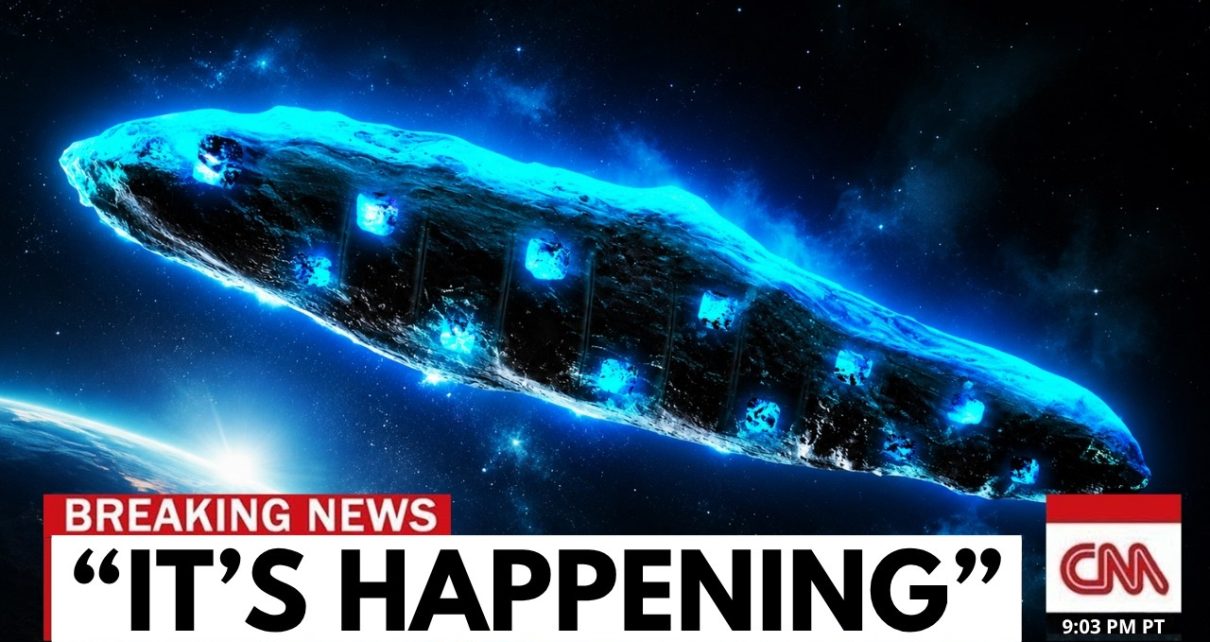
The gigantic blue vessel shown in sensational online artwork is not a verified Euclid observation, and Euclid has released no evidence of an alien spacecraft approaching Earth. The telescope’s real discoveries are arguably more important. By studying subtle distortions in the shapes of galaxies, researchers can trace invisible concentrations of dark matter, while the distribution and movement of galaxies may reveal how dark energy has influenced the expansion of the universe. According to the European Space Agency, Euclid’s initial deep-field release included millions of sources and demonstrated its exceptional ability to survey huge regions of space with both sharpness and speed. Artificial-intelligence systems, citizen scientists, and professional astronomers are now examining vast numbers of candidate objects, searching for rare lenses and structures that conventional surveys may have missed. Every strange arc could magnify a galaxy otherwise too distant to study, while every unexpected pattern could provide another clue about how matter is distributed throughout the cosmos. Therefore, the real breaking news is not that Euclid photographed an enormous alien ship, but that it has opened an unprecedented window onto the hidden architecture of the universe. These images remain “unexplained” only in the scientific sense: they are questions awaiting careful measurements, independent confirmation, and physical models. As Euclid continues its survey, some mysteries will receive familiar explanations, while others may challenge existing theories of gravity, galaxy formation, or cosmic expansion. What is happening is not an invasion from space, but the beginning of a vast new era of discovery—one in which the universe may prove stranger, darker, and more complex than the dramatic images imagined online.