The James Webb Space Telescope has detected intriguing chemical signals in the atmosphere of K2-18 b, a distant exoplanet that has become one of the most closely watched targets in the search for life beyond Earth.
Located approximately 124 light-years away in the constellation Leo, K2-18 b orbits within the habitable zone of a cool red-dwarf star, where temperatures could theoretically permit liquid water under suitable atmospheric conditions. Webb’s observations have confirmed methane and carbon dioxide in the planet’s hydrogen-rich atmosphere, while showing relatively little ammonia—a combination that some researchers believe may be consistent with a vast ocean beneath the atmosphere. More recent data from Webb’s Mid-Infrared Instrument revealed possible absorption features associated with dimethyl sulfide, or DMS, and dimethyl disulfide, known as DMDS.
On Earth, DMS is produced mainly by living organisms, particularly microscopic marine life, making it an interesting potential biosignature. The research team reported the signal at approximately three-sigma significance, corresponding to a statistical confidence near 99.7 percent under the assumptions of its model. However, that figure describes confidence in a feature within the data; it does not mean there is a 99.7 or 99.9 percent probability that life exists on the planet. Random noise, instrumental effects, data-processing choices, or another molecule with a similar infrared signature could potentially create the same pattern.
Independent researchers analyzing Webb’s complete spectrum have subsequently found insufficient evidence to confirm either DMS or DMDS, demonstrating that the interpretation remains controversial. K2-18 b is also very different from Earth. It has a radius approximately 2.6 times greater than Earth’s and a mass more than eight times larger, placing it in the category of sub-Neptune planets. Scientists do not yet know whether it possesses a habitable ocean, a deep layer of high-pressure ice, or an atmosphere so thick that conditions below would be hostile to known life.
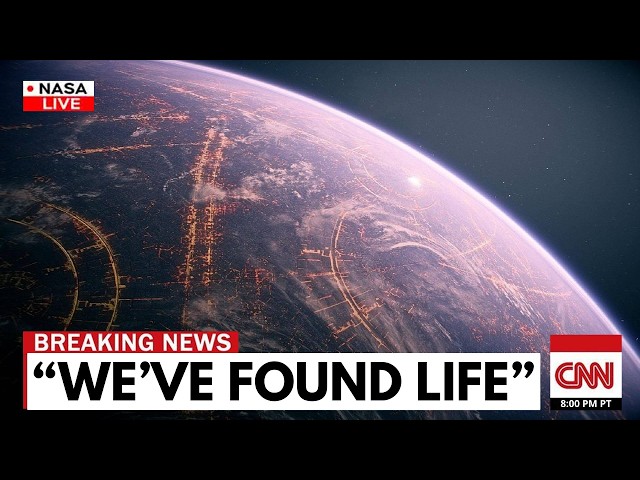
The European Space Agency stresses that occupying a star’s habitable zone and containing carbon-bearing molecules do not automatically make a planet habitable. Webb has not photographed continents, artificial lights, cities, or biological organisms on K2-18 b. The richly detailed planet shown in the accompanying thumbnail is an artistic visualization, because the exoplanet appears to telescopes only as unresolved light passing in front of its star.
Astronomers determine atmospheric composition by studying the tiny portion of starlight filtered through the planet’s gases during a transit. Different molecules absorb characteristic wavelengths, leaving chemical fingerprints in the spectrum. Confirming life would require repeated observations, stronger statistical evidence, independent analyses, and the elimination of plausible nonbiological chemistry.
Even then, scientists would seek several mutually supporting biosignatures rather than rely on a single molecule. Webb has therefore not found a planet with a 99.9 percent chance of life. It has identified a world with fascinating chemistry and produced a possible, heavily debated biosignature—the kind of tantalizing result that could guide humanity toward a genuine discovery while reminding us how difficult it is to distinguish life from chemistry across more than a hundred light-years.