NASA Just Saw Saturn After 50 Years — And Something Is Wrong
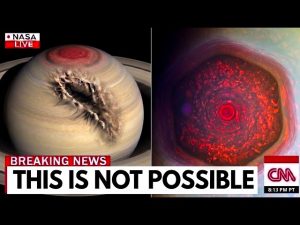
PASADENA, California — Nearly half a century after NASA’s Pioneer 11 and Voyager spacecraft delivered humanity’s first detailed close-range views of Saturn, modern observations have revealed a planet that appears far stranger and more dynamic than scientists once understood. New infrared data, combined with decades of measurements from Voyager, Cassini, Hubble, and ground-based observatories, show major changes unfolding in Saturn’s atmosphere and rings. The most dramatic feature is the enormous six-sided storm surrounding the planet’s north pole.
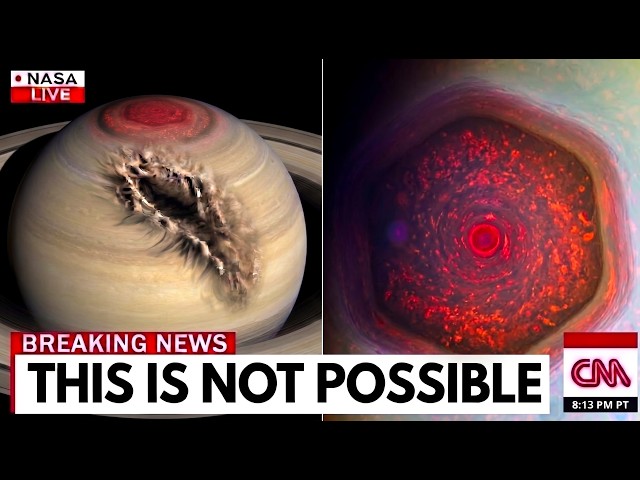
Known as Saturn’s hexagon, this persistent atmospheric structure is wider than Earth and is formed by a powerful jet stream moving through the planet’s upper atmosphere. Inside it, a vast polar cyclone continues to rotate while smaller storms, clouds, and waves move around its edges. The red, fiery appearance shown in the accompanying viral image is not what a person would see with the naked eye; it is a heavily enhanced illustration resembling false-color infrared data, in which invisible wavelengths are assigned visible colors to reveal temperature and atmospheric composition.
NASA has not reported a physical hole, alien structure, or burning opening in Saturn. Nevertheless, researchers have documented genuine changes. Saturn takes approximately 29 Earth years to orbit the Sun, meaning each season lasts more than seven years. As sunlight shifts from one hemisphere to the other, temperatures, haze, wind patterns, and cloud colors can change substantially. The north polar region that Voyager observed in the early 1980s was hidden in winter darkness when Cassini arrived in 2004, but later emerged into sunlight, giving scientists an unprecedented opportunity to watch the hexagon evolve across seasons.
Observations have shown variations in its color and surrounding haze, probably caused by changes in ultraviolet sunlight and photochemical reactions. Saturn’s famous rings are also changing. Cassini detected material from the rings entering the planet’s upper atmosphere—a process often called “ring rain”—while other measurements suggest that tiny ice particles are gradually being lost. This does not mean the rings are about to vanish; estimates of their remaining lifetime vary widely, and the system could persist for tens or hundreds of millions of years. From Earth, however, they periodically appear to disappear when Saturn’s extremely thin ring plane turns edge-on to our line of sight.
Scientists are also investigating powerful storms that can erupt in Saturn’s atmosphere, sometimes expanding until they encircle much of the planet. These events may be driven by heat rising from deep inside the gas giant, where pressures and temperatures are far beyond anything experienced on Earth. Saturn therefore is not “broken,” and NASA has announced no planetary emergency. What has changed is the precision with which astronomers can examine it. Each generation of instruments exposes features that older spacecraft could not detect, transforming a seemingly calm, pale world into a turbulent system of storms, chemical reactions, shifting seasons, and eroding rings. As NASA’s Saturn overview explains, the planet remains one of the most complex worlds in the solar system. Something may look wrong—but the unsettling truth is that Saturn was probably this strange all along.