NASA Just Reanalyzed the Moon: This Is What They Actually Found

NASA scientists are taking another look at the Moon using modern instruments, newly processed spacecraft observations and Apollo samples preserved for more than five decades—and the emerging picture is far more complicated than the cold, geologically dead world once described in textbooks. Some Apollo material was deliberately stored unopened so that future researchers could examine it with technologies unavailable in the 1960s and 1970s.
Through the Apollo Next Generation Sample Analysis program, scientists have opened carefully sealed containers and studied lunar soil, rock and trapped gases with extremely sensitive laboratory equipment. Their results support evidence that water and other volatile substances are present in lunar material, although not as underground oceans or flowing rivers. Water molecules can be chemically bound inside minerals, deposited in tiny glass beads formed by ancient volcanic eruptions, or preserved as ice within permanently shadowed craters near the poles, where temperatures remain exceptionally low.
Orbital observations have also revealed widespread hydroxyl—molecules containing hydrogen and oxygen—across portions of the surface, suggesting a changing water cycle influenced by sunlight, temperature and the solar wind. Researchers are equally interested in indications that the Moon’s volcanic history lasted much longer than previously believed. Apollo samples recorded eruptions billions of years ago, while younger volcanic deposits identified through remote sensing and samples returned by other lunar missions suggest that molten material may have reached the surface relatively late in the Moon’s history.
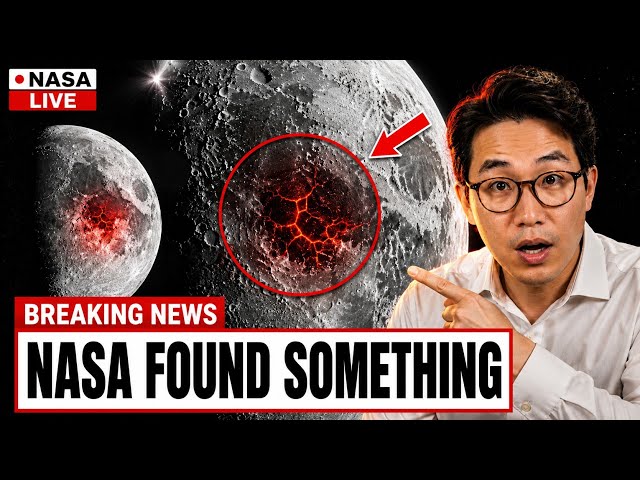
That does not mean active lava is currently breaking through the crust. The fiery red crater displayed in the accompanying thumbnail is a digitally created illustration, not an authentic NASA photograph of a present-day lunar eruption, secret reactor or unexplained energy source. Scientists have found no evidence that the Moon is cracking open or that an artificial structure lies beneath the highlighted region. The genuine findings are nevertheless dramatic. Reanalysis of seismic recordings left by Apollo has improved models of the Moon’s interior, indicating a layered structure that includes a crust, mantle and small metallic core.
Researchers have also documented shallow moonquakes, landslides and surface changes produced by impacts and extreme temperature cycles, demonstrating that “inactive” does not mean completely motionless. Meanwhile, mapping from NASA’s Lunar Reconnaissance Orbiter continues to identify potential ice-bearing areas and hazardous terrain that could influence future Artemis landing sites. Polar ice is particularly important because it preserves a record of substances delivered by comets, asteroids and the solar wind, while potentially providing future explorers with water, oxygen and hydrogen.
NASA’s renewed examination therefore has not uncovered aliens, glowing caverns or a concealed lunar city. Instead, it has revealed something scientifically more valuable: the Moon is an archive of solar-system history whose rocks retain chemical evidence erased long ago from Earth by weather, oceans and plate tectonics. Every improvement in laboratory sensitivity allows researchers to ask new questions of the same irreplaceable samples, which is why material collected by astronauts more than 50 years ago continues to produce discoveries today. The Moon has not suddenly transformed; humanity has simply become better equipped to read the history written across its surface and locked inside its ancient stones.