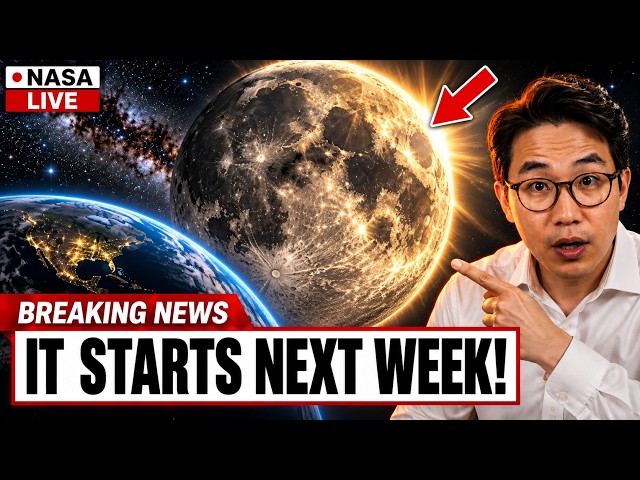
The Moon Is About to Do Something Nobody Alive Has Seen — Starting Next Week

The Moon will command the night sky starting next week, but not because it is cracking apart, approaching Earth, or preparing to trigger a global catastrophe—as the dramatic image circulating online might suggest. Instead, skywatchers will witness a constantly changing lunar landscape that is technically unique: because the Moon’s orbit, libration, lighting angle, and viewing conditions never repeat in precisely the same combination, each night presents a perspective that no living observer has seen in exactly that form.
Following September’s bright Harvest Moon, the lunar disk will begin waning as it continues its 29.5-day journey around Earth, rising progressively later and allowing the boundary between daylight and darkness—known as the terminator—to sweep across its surface. Along that moving line, low sunlight will cast long shadows from mountains, crater walls, and ancient lava plains, briefly revealing details that are far harder to notice under the flat illumination of a full Moon. Through binoculars or a small telescope, observers may see famous features such as the dark Mare Imbrium, the bright rays of Tycho Crater, and the rugged highlands appearing to change shape from one evening to the next. Atmospheric conditions can make the spectacle look even more dramatic.
When the Moon is close to the horizon, its light travels through a thicker layer of Earth’s atmosphere, scattering shorter blue wavelengths and leaving it glowing yellow, orange, or occasionally deep red. The familiar “Moon illusion” may also make it appear unusually enormous beside buildings, trees, or the horizon, although photographs and orbital calculations confirm that it is not suddenly swelling or moving dangerously close to our planet. Contrary to sensational claims, NASA has issued no warning of an unprecedented lunar emergency, and the fiery, oversized Moon shown in the accompanying thumbnail is a digitally constructed illustration rather than an authentic scientific image.
The Moon is not becoming molten, no impact is forecast, and its changing appearance poses no threat to Earth. What makes the coming nights significant is not an impossible physical transformation but an opportunity to observe our nearest celestial neighbor as a dynamic world rather than a static object. The Moon’s visible phases result from the changing geometry among the Sun, Earth, and Moon, while its apparent wobble, called libration, lets observers gradually glimpse slightly more than half of the lunar surface over time. Combined with shifting shadows and differences in atmospheric clarity, that motion ensures that every observing session can reveal something new.
Astronomers therefore encourage viewers to step outside, allow their eyes to adjust to the darkness, and examine the Moon repeatedly throughout the week. The real event may be less apocalyptic than the headline implies, but it remains extraordinary: an ancient world changing before our eyes, one night and one shadow at a time. NASA’s lunar overview explains the science behind these phases and apparent changes.