Scientists Still Can’t Fully Explain ʻOumuamua—and It Has Left Everyone Confused
Nearly a decade after ʻOumuamua raced through our solar system, scientists still cannot completely agree on what the mysterious interstellar visitor was or how it behaved. Officially designated 1I/2017 U1, the object was discovered on October 19, 2017, by the Pan-STARRS1 telescope in Hawaii after it had already passed its closest point to the Sun. Its hyperbolic trajectory showed that it was not gravitationally bound to our star, making it the first object confirmed to have entered the solar system from interstellar space.
From the beginning, however, ʻOumuamua resisted easy classification. Astronomers initially called it a comet, but observations revealed no obvious coma—the glowing cloud of gas and dust normally produced as a comet warms near the Sun. It was then treated more like an asteroid, yet its extreme brightness variations suggested an unusually elongated or flattened shape tumbling chaotically through space. The greatest puzzle emerged when precise tracking showed that ʻOumuamua received a small additional push as it moved away from the Sun. Gravity alone could not fully explain the acceleration.
The leading natural explanation is that gases escaped from its surface and acted like tiny thrusters, a familiar process in comets. But telescopes did not clearly detect the dust or conventional gases researchers expected to accompany such activity. NASA nevertheless describes comet-like outgassing as the most likely source of the object’s unexpected speed boost. Alternative models have proposed that ʻOumuamua was rich in hydrogen, nitrogen or other volatile ice that could evaporate without producing a bright, easily visible tail
Other researchers have suggested it may have been an extremely porous fragment, a thin sheet of material or debris blasted from the surface of a distant planetary body. None of these explanations has yet resolved every observational detail. Its strange properties inevitably inspired claims that it might have been artificial, perhaps even a probe created by another civilization. Most astronomers stress that there is no direct evidence supporting that interpretation: no verified radio transmission, controlled maneuver or technological structure was detected.
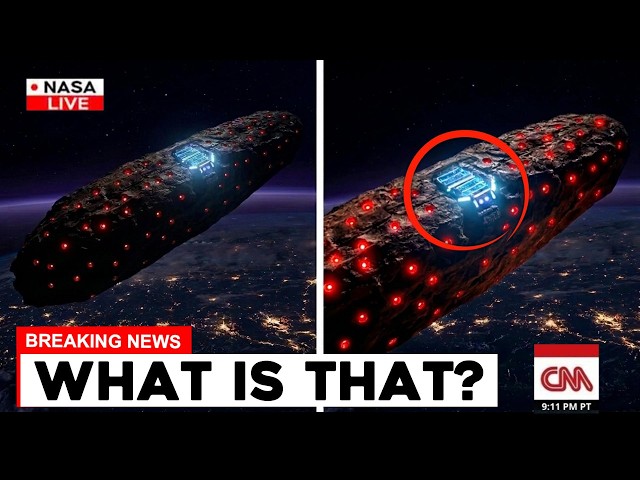
The dramatic cigar-shaped objects commonly shown in illustrations are artistic reconstructions, not close-up photographs; ʻOumuamua appeared only as an unresolved point of light in telescope data, so its exact shape remains uncertain. NASA notes that its complex rotation makes multiple physical models possible. Unfortunately, the visitor was already escaping when scientists recognized its significance, and it is now far too faint for detailed observation with existing telescopes. Researchers must therefore work with a limited archive of measurements while preparing to detect future interstellar arrivals earlier. ʻOumuamua may ultimately prove to be an unfamiliar but entirely natural type of cometary fragment. For now, it remains a powerful reminder that objects formed around other stars can reach our neighborhood—and that the galaxy may contain worlds and materials stranger than anything scientists have yet classified.