NASA Just Did Something It Probably Shouldn’t Have

NASA has spent decades doing something that once sounded like science fiction: deliberately sending spacecraft toward asteroids, comets, and other potentially dangerous objects to discover whether humanity could someday protect Earth from a catastrophic impact.
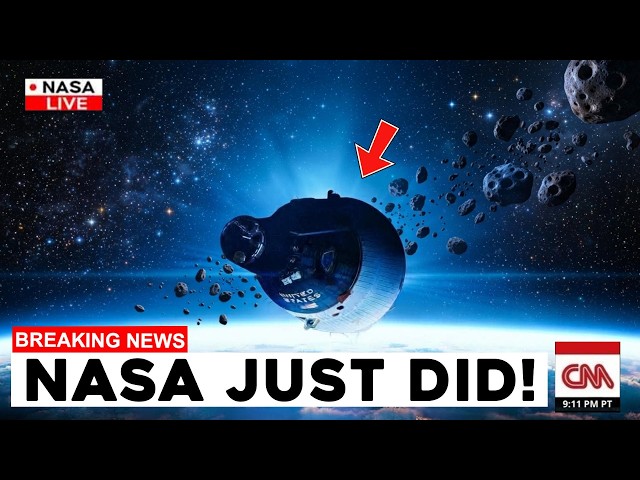
The dramatic image above appears to show a spacecraft surrounded by enormous space rocks, but there is no confirmed NASA report that a spacecraft has accidentally entered a deadly asteroid swarm or triggered an immediate threat to our planet. The real story behind NASA’s experiments with asteroids, however, is almost as dramatic. In September 2022,
NASA intentionally crashed its DART spacecraft into Dimorphos, a small moon orbiting the asteroid Didymos, at roughly 14,000 miles per hour. It was humanity’s first full-scale test of planetary defense technology. The goal was not to destroy the asteroid but to determine whether a spacecraft could change an asteroid’s motion through a technique known as kinetic impact. Before the collision, Dimorphos took 11 hours and 55 minutes to orbit Didymos. NASA later determined that the impact shortened that orbit by approximately 33 minutes, demonstrating that humans can measurably alter the trajectory of a celestial body. But the experiment also produced effects that scientists are still studying. The impact blasted a huge cloud of rocks and dust into space, creating a debris tail thousands of kilometers long. Observations from the Hubble Space Telescope revealed dozens of boulders drifting away from Dimorphos after the collision, while later research showed that the asteroid’s response was more complicated than simply receiving a single push from the spacecraft. Material ejected by the impact carried momentum of its own, increasing the overall deflection. That complexity explains why scientists are continuing to analyze the experiment rather than assuming that one successful collision provides a universal solution to asteroid defense. Asteroids differ dramatically in composition and internal structure. Some are solid bodies, while others may be loosely bound collections of rocks and dust known as “rubble piles.” Striking the wrong object without understanding its structure could therefore produce results different from those observed at Dimorphos.
NASA also deliberately collects material from asteroids. Its OSIRIS-REx mission briefly contacted asteroid Bennu in 2020, gathered rocks and dust, and returned the sample to Earth in 2023. Scientists subsequently discovered carbon-rich material, salts, amino acids and nucleobases within the sample—chemical ingredients that provide clues about conditions in the early Solar System. These missions may look reckless when reduced to a sensational headline like “NASA Just Did Something It Probably Shouldn’t Have,” but they are carefully planned scientific experiments designed to answer an extremely practical question: what could humanity do if astronomers discovered an asteroid on a collision course with Earth? DART provided the first real-world evidence that deflection is possible, while missions to Bennu and other asteroids are helping researchers understand what these objects are actually made of.
NASA has not created a dangerous asteroid swarm headed toward Earth. Instead, scientists are deliberately confronting one of nature’s oldest planetary hazards so that, if a genuine threat is ever detected, humanity may have more options than simply watching it approach.