SpaceX Just Did Something Impossible in 13 Hours — Scientists Are Stunned

SpaceX has once again demonstrated how dramatically orbital transportation has evolved, completing a complex journey from Earth to the International Space Station in a matter of hours—an operation that combines launch, orbital pursuit, precision navigation and autonomous docking while both spacecraft travel around the planet at roughly 17,500 miles per hour.
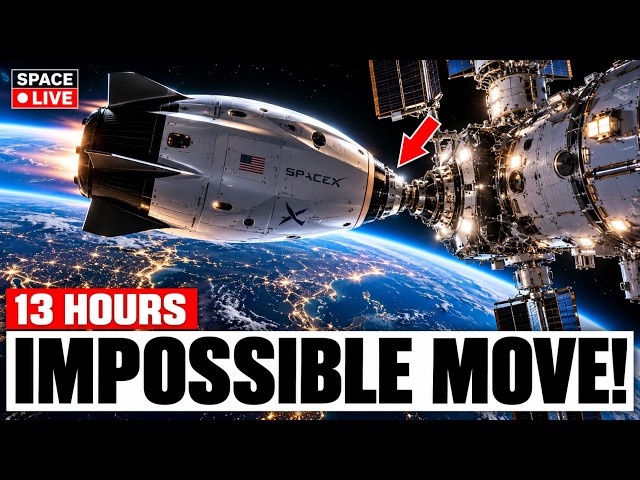
The dramatic image accompanying the headline depicts a SpaceX Crew Dragon approaching an orbital station and describes the event as an “IMPOSSIBLE MOVE,” but nothing about such a rendezvous violates the laws of physics. Instead, the achievement highlights decades of advances in spacecraft guidance, automation and orbital mechanics.
After launching aboard a Falcon 9 rocket, Crew Dragon does not simply point toward the International Space Station and fly directly to it. The spacecraft must first enter a carefully calculated orbit below the station, where its slightly higher orbital speed allows it to gradually catch up. Dragon then performs a sequence of precisely timed engine burns that raise its orbit while adjusting its speed and position until the two vehicles are traveling together.
Even a small navigation error can translate into a significant separation over time, which is why computers on Dragon continuously calculate its relative position while ground controllers closely monitor the approach. SpaceX’s Dragon spacecraft One of Dragon’s defining capabilities is its largely autonomous rendezvous and docking system. Cameras, thermal sensors and navigation software allow the spacecraft to identify the station, calculate distance and closing speed, and carefully approach a docking port. During the final phase, Dragon slows to extremely low relative speeds despite both vehicles racing around Earth at orbital velocity.
The spacecraft then establishes physical contact, engages its docking mechanisms and forms a secure, pressurized connection before astronauts are permitted to open the hatches. NASA and SpaceX have demonstrated variations of this process repeatedly through Commercial Crew missions, turning what once represented an extraordinary experimental challenge into an increasingly standardized operation. NASA Commercial Crew Program A roughly 13-hour launch-to-docking profile would therefore be impressive, but it should not be interpreted as something scientists considered impossible.
The exact duration of any Crew Dragon rendezvous depends on the International Space Station’s position at launch, the selected orbital trajectory, mission requirements, weather and operational considerations. Some missions reach the station relatively quickly, while others intentionally spend substantially longer in free flight. What makes the process remarkable is the precision involved: engineers must launch during a narrow window so Dragon enters an orbit that allows it to intercept a laboratory moving several kilometers every second hundreds of kilometers above Earth.
The image itself should also be treated as an illustrative visualization rather than documentary evidence of a newly announced docking emergency or unprecedented maneuver. There is no indication in the picture alone that SpaceX performed a dangerous or physically impossible operation.
The real accomplishment is more meaningful than the sensational wording suggests. A reusable spacecraft can now launch people from Earth, place them into orbit, autonomously chase another spacecraft around the planet and dock with it within the span of a single day.
These capabilities are important not only for the ISS but also for future missions requiring increasingly complicated rendezvous, docking and crew-transfer operations. As human exploration moves toward commercial space stations, the Moon and eventually Mars, rapid and reliable orbital navigation will become increasingly valuable.
SpaceX did not break the laws of physics in 13 hours—it used them with extraordinary precision, turning one of spaceflight’s most demanding maneuvers into something that can now be performed repeatedly with astronauts aboard.