NASA Found Something Strange Beyond Pluto — Is This Planet X??
Astronomers searching the frozen frontier beyond Pluto are confronting one of the Solar System’s most intriguing mysteries: could a massive, undiscovered planet be hiding in the darkness far beyond Neptune?

Often called “Planet Nine” and popularly associated with the older term “Planet X,” the hypothetical world has never been directly photographed, yet unusual orbital patterns among some extremely distant objects have kept the idea alive. Researchers first drew major attention to the modern Planet Nine hypothesis after noticing that several trans-Neptunian objects appeared to have strangely clustered orbits.
One possible explanation is the gravitational influence of an unseen planet many times more massive than Earth, traveling around the Sun at an enormous distance. If such a world exists, it could take thousands or even tens of thousands of years to complete a single orbit, making it exceptionally difficult to locate. At those distances, sunlight would be extremely weak, and even a relatively large planet could appear as little more than a faint point of light against a dense background of stars.
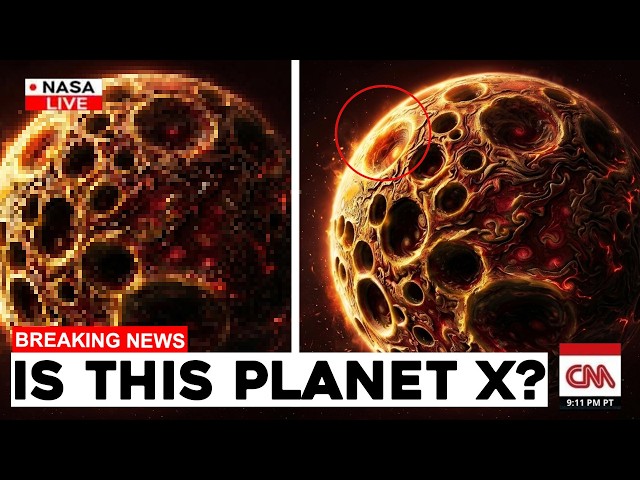
NASA emphasizes that the proposed planet remains hypothetical rather than confirmed. NASA’s overview of the Planet Nine hypothesis The mystery has become more complicated because alternative explanations exist for the unusual orbital patterns. The apparent clustering could be influenced by observational bias: astronomers do not survey every region of the sky equally, meaning discoveries may naturally accumulate in locations where telescopes have searched most intensively. Other researchers have proposed that the combined gravitational influence of many smaller bodies could potentially produce some unusual effects without requiring a giant hidden planet. New discoveries in the distant Solar System are therefore critically important. Each newly identified object acts almost like a gravitational clue, allowing scientists to reconstruct what unseen forces may have shaped its orbit over billions of years. Powerful surveys are expected to dramatically expand the known population of distant icy bodies, providing a much stronger test of the Planet Nine hypothesis. If researchers eventually discover a large planet beyond Pluto, it would be one of the most important Solar System discoveries in generations and could transform theories about how the giant planets formed and migrated. Some models suggest a distant planet could have originated closer to the Sun before gravitational interactions pushed it into an enormous outer orbit. Others raise the possibility that an unusual world might have been captured during the Sun’s early history, although such scenarios remain speculative. The spectacular object shown in the accompanying thumbnail, however, should not be interpreted as a genuine NASA photograph of Planet X. Its glowing, crater-covered surface and fiery appearance are artistic or sensationalized imagery; astronomers have not obtained a detailed close-up image of a newly discovered planet beyond Pluto. Nor is there evidence that a hidden planet is approaching Earth or threatening the Solar System. The genuine mystery is far subtler—and scientifically more compelling. Something may be influencing the architecture of the distant outer Solar System, but researchers are still determining whether that “something” is an undiscovered planet, statistical coincidence, observational bias, or another mechanism entirely.
Planet X has not been found, but the possibility that a massive unseen world could still be waiting beyond Pluto reminds us of an astonishing fact: even our own Solar System may still contain major worlds humanity has never seen.