1 MINUTE AGO: James Webb RECORDED The Terrifying Sound!

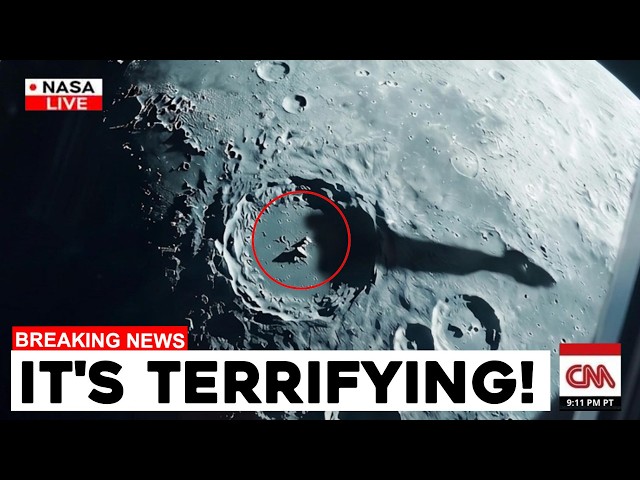
A mysterious sound supposedly captured by NASA’s James Webb Space Telescope has sparked extraordinary speculation about what might be hiding in the darkness of space. Sensational headlines suggest that the powerful observatory has recorded a terrifying noise originating from a distant celestial object, raising unsettling questions about whether the universe contains phenomena humanity has never encountered before. The accompanying image shows a heavily cratered surface with a strange formation highlighted inside a massive depression, creating the impression that scientists have discovered something unnatural. But did James Webb really record a frightening sound from space, or is the truth behind these mysterious cosmic signals even more fascinating?
The James Webb Space Telescope, launched in December 2021, was designed to investigate the universe primarily through infrared light. Its sophisticated instruments allow astronomers to study ancient galaxies, distant planets, star-forming regions, and the chemical composition of celestial objects.
However, there is one crucial scientific detail often overlooked in dramatic stories about sounds from space: James Webb does not carry a conventional microphone designed to record sounds traveling through the vacuum of space.
Sound normally requires a physical medium, such as air, water, or another material, to travel. Because most of outer space is an extremely thin vacuum, ordinary sound waves cannot propagate through it the way they do on Earth.
Nevertheless, scientists have developed fascinating techniques for transforming astronomical measurements into sounds that humans can hear.
This process, known as data sonification, converts information such as brightness, position, frequency, or intensity into audible tones.
NASA has released sonifications of astronomical observations, allowing audiences to experience scientific data through sound rather than images alone.
Some of these recordings feature eerie whistles, deep rumbling tones, or unusual rhythmic patterns that resemble sounds from science-fiction films.
But these audio representations are not necessarily actual noises traveling through space. Instead, they are interpretations of scientific measurements.
One remarkable example involves the Perseus galaxy cluster, where researchers identified pressure waves moving through extremely hot gas surrounding a supermassive black hole.
Because the cluster contains gas, pressure waves can propagate through that material. NASA transformed the associated measurements into an audible presentation by shifting their frequencies dramatically upward.
The resulting sound attracted worldwide attention because of its haunting, almost supernatural quality.
Yet it did not represent a mysterious alien transmission.
James Webb has also produced extraordinary observations of regions where stars are being born, including the famous Pillars of Creation within the Eagle Nebula.
Its infrared instruments reveal intricate clouds of gas and dust, energetic young stars, and complex structures shaped by stellar radiation.
Scientists can convert information from such images into sound, creating an entirely different way to explore the universe.
The accompanying thumbnail appears to show a cratered planetary or lunar surface with an unusual dark formation circled in red.
However, there is no verified evidence that James Webb photographed an alien structure inside this crater or recorded a terrifying sound originating from it.
The image should not be treated as authenticated documentation of a newly discovered extraterrestrial object.
Webb is primarily an astronomical observatory, not a spacecraft designed to fly close to planetary surfaces and investigate individual craters.
The telescope’s discoveries are nevertheless transforming astronomy. By examining infrared radiation from distant celestial objects, researchers can investigate phenomena that were previously hidden behind enormous clouds of dust.
Its observations are helping scientists understand the formation of stars, the evolution of galaxies, and the atmospheres of planets orbiting other stars.
Meanwhile, radio telescopes and other specialized instruments continue investigating electromagnetic signals from space, including natural emissions produced by energetic astronomical processes.
The most astonishing revelation is not that James Webb has recorded a terrifying alien scream—it hasn’t—but that the universe contains extraordinary physical processes whose measurements can be transformed into sounds unlike anything humans normally experience. And as scientists continue translating the hidden signals of the cosmos, the universe may have many more surprising stories left to tell.