Standard Model Is Over! James Webb Telescope Detects The S8 Anomaly Nobody Was Looking For
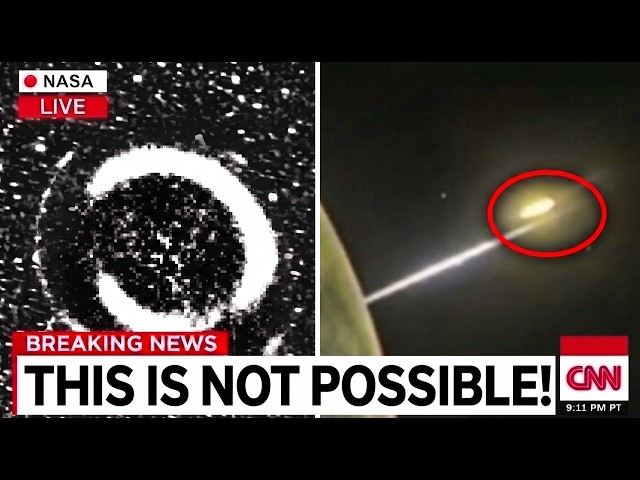
A mysterious discrepancy in the structure of the universe is raising one of the most fascinating questions in modern cosmology: what if the universe is not behaving exactly as scientists predicted? As NASA’s James Webb Space Telescope continues exploring distant galaxies, researchers are investigating whether observations of cosmic structure agree with the theoretical framework that has guided astronomy for decades. A dramatic image circulating online shows an unusual glowing ring and a brilliant object emitting a narrow beam of light, accompanied by the alarming warning, “THIS IS NOT POSSIBLE!” The headline suggests that Webb has discovered an anomaly powerful enough to overturn the Standard Model of cosmology. But has the telescope really uncovered evidence that our understanding of the universe is fundamentally wrong, or are astronomers confronting a subtle disagreement between theoretical predictions and astronomical measurements?
At the center of this mystery is a quantity known as S8, which describes the amplitude of matter clustering in the universe. More precisely, S8 combines a measurement of matter fluctuations, called sigma-eight, with the present-day matter density of the cosmos.
This parameter helps scientists understand how strongly matter has gathered into enormous structures such as galaxies, galaxy clusters, and the vast cosmic web.
According to the prevailing Lambda Cold Dark Matter model, commonly abbreviated as ΛCDM, the universe contains ordinary matter, cold dark matter, and dark energy. Together, these components influence how cosmic structures grow over billions of years.
The model has been remarkably successful at explaining observations of the cosmic microwave background, the distribution of galaxies, and the expansion history of the universe.
However, a persistent discrepancy has attracted scientific attention.
Measurements inferred from the cosmic microwave background, particularly observations made by the European Space Agency’s Planck satellite, have sometimes suggested a greater degree of matter clustering than measurements obtained through certain surveys of the more recent universe.
This disagreement is commonly called the S8 tension.
If the discrepancy persists after improved measurements and analysis, it could indicate that scientists are missing something important about the evolution of cosmic structure.
One possible explanation involves dark matter.
Although dark matter has never been directly identified as a particle in laboratory experiments, its gravitational influence is supported by multiple astronomical observations. Scientists believe it plays a central role in the formation of galaxies and galaxy clusters.
If dark matter possesses properties different from those assumed in conventional models, its behavior could influence how quickly cosmic structures grow.
Another possibility involves dark energy, the mysterious component associated with the accelerating expansion of the universe.
Changes in the properties of dark energy could affect the growth of matter fluctuations over cosmic time, potentially altering the relationship between early-universe predictions and later observations.
Researchers are also investigating whether massive neutrinos, complex astrophysical processes, or limitations in current measurement techniques could contribute to the apparent disagreement.
But where does the James Webb Space Telescope fit into this mystery?
Webb is not primarily designed to measure S8 directly. Instead, its extraordinary infrared sensitivity allows astronomers to observe extremely distant galaxies, study their physical properties, and investigate the formation of cosmic structures during the universe’s earliest periods.
These observations provide valuable information about how matter assembled into stars and galaxies.
Some Webb discoveries have revealed surprisingly luminous galaxies that existed only a few hundred million years after the Big Bang. Their properties have encouraged scientists to reconsider assumptions about early star formation and galaxy growth.
However, there is no established evidence that Webb has independently detected a new S8 anomaly that overturns the standard cosmological model.
The S8 tension was already being investigated before Webb began scientific operations.
Much of the research involves weak gravitational lensing, a phenomenon in which the gravity of matter subtly distorts the apparent shapes of distant galaxies.
By analyzing these distortions across enormous regions of the sky, astronomers can estimate how matter is distributed throughout the universe.
Projects such as the Dark Energy Survey, the Kilo-Degree Survey, and the Hyper Suprime-Cam survey have contributed important measurements to this debate.
The European Space Agency’s Euclid mission is also designed to investigate cosmic structure with exceptional precision, potentially helping scientists determine whether the discrepancy reflects new physics or previously unrecognized observational effects.
The sensational thumbnail accompanying the headline presents another intriguing visual mystery.
Its bright circular formation resembles a gravitationally distorted astronomical object, while the glowing structure on the opposite side appears to emit an intense beam of radiation.
Yet the image cannot be authenticated as a Webb observation demonstrating the S8 tension. Its unusual shapes do not, by themselves, provide evidence that the laws of physics have failed.
Cosmic rings can arise through gravitational lensing, while apparent beams or streaks in astronomical imagery may have several natural or instrumental explanations.
Authentic scientific conclusions require carefully calibrated measurements, independent observations, and detailed statistical analysis.
Another important distinction concerns the phrase “Standard Model.”
The Standard Model of particle physics describes fundamental particles and three of the four known fundamental interactions. The standard cosmological model, ΛCDM, describes the universe’s large-scale evolution and composition.
Although these frameworks are connected through fundamental physics, an unresolved cosmological discrepancy does not automatically invalidate the Standard Model of particle physics.
Ultimately, the S8 tension is a genuine scientific question, but it has not established that cosmology is broken or that James Webb has discovered an impossible new force.
What makes the anomaly exciting is the possibility that increasingly precise observations could reveal subtle limitations in our current theories.
If future measurements confirm a significant disagreement between the early and late universe, scientists may need to reconsider how dark matter, dark energy, or gravity influence cosmic evolution.
But if improved observations resolve the tension, that outcome would also represent an important achievement, strengthening confidence in the existing cosmological framework.
The universe may not be broken. Instead, humanity may be approaching the limits of what its current measurements can reveal.
What do you think? If the S8 anomaly remains unresolved, could it point toward an unknown property of dark matter, a changing form of dark energy, or an entirely new theory of gravity? And if scientists eventually discover that the universe forms structures differently than expected, how much of modern cosmology might need to change? Share your thoughts in the comments!