James Webb Just Saw Saturn Rings For The First Time – And It’s Not Possible

A fascinating new wave of speculation surrounding NASA’s James Webb Space Telescope has drawn attention to one of the most spectacular and mysterious structures in our solar system: Saturn’s rings. Dramatic images circulating online appear to show enormous sections of the planet’s famous ring system disappearing into darkness, raising questions about whether astronomers have discovered something unexpected happening around the gas giant. But while the images suggest a shocking cosmic event, the real scientific story involves an extraordinary combination of changing viewing angles, icy particles, gravitational forces, and the remarkable capabilities of modern space telescopes.
Saturn has fascinated astronomers for centuries. Its magnificent rings, composed primarily of countless particles of water ice mixed with rocky material and dust, extend hundreds of thousands of kilometers around the planet. Despite their enormous width, the main rings are remarkably thin, measuring only tens of meters thick in many regions.
NASA’s Voyager spacecraft provided detailed observations of Saturn during the early 1980s, revealing complicated ring structures, narrow gaps, and gravitational interactions involving the planet’s moons. Later, the Cassini spacecraft transformed our understanding of the Saturnian system during its mission from 2004 to 2017.
Now, the James Webb Space Telescope offers scientists another powerful way to investigate this distant world.
Using infrared observations, Webb can study Saturn’s atmosphere, rings, and surrounding environment in wavelengths that reveal information not easily visible through ordinary optical telescopes.
Infrared measurements help researchers examine the composition and distribution of ring particles while investigating how sunlight interacts with icy material.
However, one of Saturn’s most surprising characteristics is that its rings can appear to disappear entirely when viewed from Earth.
This phenomenon occurs because Saturn’s rotational axis is tilted approximately 26.7 degrees relative to its orbital plane.
As Saturn travels around the Sun during its roughly 29.4-year orbit, our viewing angle toward its rings gradually changes.
At certain times, Earth passes through the plane of Saturn’s rings, causing the enormous structures to appear almost invisible because we are observing them edge-on.
A ring-plane crossing occurred in March 2025, demonstrating how dramatically Saturn’s appearance can change without the rings actually vanishing.
This remarkable optical effect has occasionally inspired sensational headlines suggesting that Saturn is losing its rings overnight.
But the scientific explanation is considerably more interesting.
Although Saturn’s rings remain present during these events, their extremely thin structure makes them difficult to observe from certain perspectives.
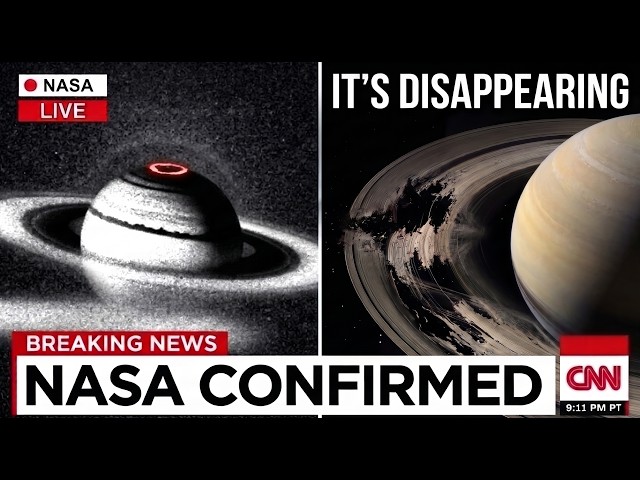
The dramatic thumbnail accompanying this story appears to depict a much more destructive scenario, with enormous dark regions spreading across Saturn’s ring system.
There is no verified evidence that Webb has photographed Saturn’s rings being suddenly destroyed or consumed by an unknown cosmic force. The thumbnail should not be interpreted as an authenticated scientific image.
Nevertheless, Saturn’s rings are undergoing genuine long-term changes.
Research using spacecraft observations has shown that icy particles from the rings can gradually enter Saturn’s atmosphere through a process sometimes called ring rain.
This phenomenon occurs when charged particles interact with Saturn’s magnetic field and atmospheric environment, contributing to the transport of material away from the rings.
Other processes, including collisions, gravitational interactions, and the movement of dust, also influence how the ring system evolves.
Scientists continue debating the precise age of Saturn’s rings and how long they may survive.
Some research suggests that the rings could be relatively young compared with Saturn itself, while other studies indicate a more complicated history.
Their eventual evolution may dramatically change the planet’s appearance over astronomical timescales.
Webb’s observations are especially valuable because they complement earlier discoveries made by Cassini.
While Cassini investigated Saturn from close range, Webb can examine the planet remotely using highly sensitive infrared instruments.
Together with observations from Hubble and ground-based telescopes, these measurements allow scientists to study seasonal changes, atmospheric chemistry, and the behavior of icy ring particles.
Saturn also possesses numerous moons, including Titan and Enceladus, that remain major targets for planetary science.
Enceladus is particularly fascinating because its subsurface ocean releases water-rich material into space through enormous plumes near its south pole.
These discoveries suggest that Saturn’s system contains far more scientific mysteries than its beautiful rings alone.
Ultimately, the James Webb Space Telescope has not revealed that Saturn’s rings are disappearing through an impossible or unexplained event.
Instead, modern observations are helping astronomers understand how one of the solar system’s most recognizable planetary features changes over time.
What appears impossible in a dramatic image may actually reveal an extraordinary example of orbital geometry and planetary physics.
And the deeper scientists investigate Saturn, the more they discover that even familiar worlds can hold remarkable surprises.
What do you think? Could Saturn’s rings eventually disappear completely, leaving the planet looking dramatically different from the world we recognize today? And if NASA launched another spacecraft to Saturn, should it investigate the mysterious rings or search for signs of life beneath Enceladus’s frozen surface? Share your thoughts in the comments!