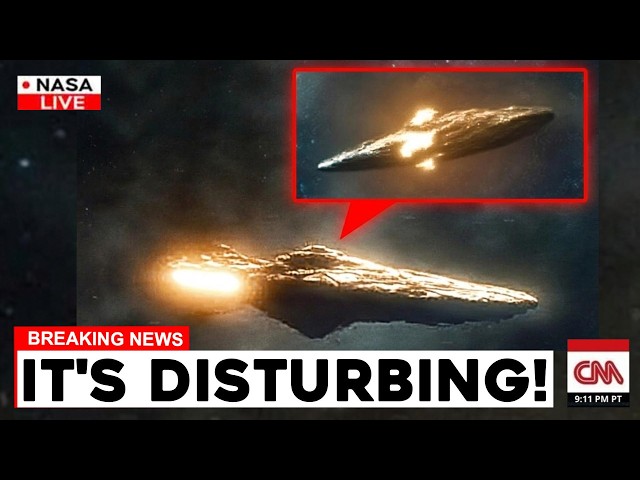

A stunning new chapter in the investigation of interstellar comet 3I/ATLAS is giving astronomers an extraordinary opportunity to study an object that originated beyond our Solar System. NASA’s James Webb Space Telescope has captured remarkable observations of this mysterious visitor, revealing important details about its chemical composition and the materials surrounding its icy nucleus. But what makes 3I/ATLAS so fascinating is not simply its appearance. It is the fact that this object traveled across interstellar space before entering our cosmic neighborhood, carrying clues about a distant planetary system that humanity has never directly explored.
Discovered on July 1, 2025, by the ATLAS survey telescope in Chile, 3I/ATLAS became the third confirmed interstellar object ever identified passing through our Solar System. Its discovery immediately attracted international attention because objects originating from other star systems are extremely rare. Unlike ordinary comets that formed around our Sun, 3I/ATLAS offers scientists a unique opportunity to examine material created in an entirely different stellar environment.
On August 6, 2025, the James Webb Space Telescope observed the interstellar visitor using its Near-Infrared Spectrograph instrument. The observations revealed an unusually prominent carbon dioxide signature surrounding the comet, alongside evidence of water vapor and other chemical compounds. These measurements are especially important because the chemical fingerprints of an interstellar object can provide clues about the conditions under which it originally formed.
Scientists have also used observations from the Hubble Space Telescope and other NASA missions to investigate its size, brightness, trajectory, and changing activity. As sunlight warms the comet, frozen materials beneath its surface turn into gas, producing a surrounding cloud known as a coma. This process creates the familiar fuzzy appearance associated with comets, although the chemistry of 3I/ATLAS appears different from many familiar Solar System examples.
Even more exciting, subsequent James Webb observations in December 2025 provided additional information about the comet’s chemical characteristics as it traveled away from the Sun. Researchers have continued investigating its unusual composition, including carbon, oxygen, and heavy hydrogen signatures that may reveal something about its ancient birthplace. These discoveries could help scientists understand how planetary systems develop around distant stars and whether the ingredients for life are widespread throughout the galaxy.
Naturally, the extraordinary nature of 3I/ATLAS has also inspired speculation about whether such an unusual visitor could be something other than a natural comet. However, there is currently no verified scientific evidence that it is an artificial spacecraft or extraterrestrial technology. Its observed characteristics are being investigated through established astronomical methods.
The biggest question may be what other secrets this ancient interstellar traveler still carries. Every new observation provides another opportunity to understand a world that formed far beyond the reach of our Sun.
Could 3I/ATLAS reveal secrets about distant planetary systems, or is there something about this mysterious visitor that scientists have yet to understand? What do YOU think?
Tham khảo khoa học: NASA – Comet 3I/ATLAS · NASA – Webb’s findings about 3I/ATLAS · ESA – Webb detects methane from 3I/ATLAS


