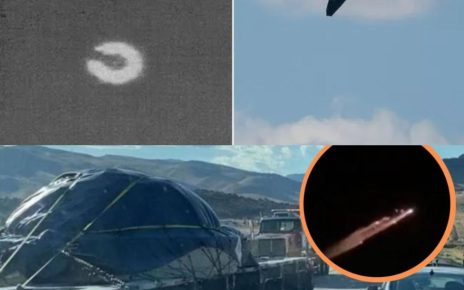
The emergence of the latest pH๏τographic evidence from clandestine archives necessitates a radical restructuring of the Chronos-Aletheia timeline, shifting our gaze from the stars to the crushing depths of the terrestrial abyss. Whistleblower Bob Lazar has dropped a mᴀssive bombshell, revealing that the UFO he famously worked on—the iconic metallic disc known as the Sport Model—was not a derelict from a distant nebula, but was actually recovered from an underwater site. The accompanying images, depicting the sleek, seamless hull of the craft within a high-security subterranean laboratory, provide the empirical backbone for a narrative that has been suppressed since the late Holocene. Historical precursors to this recovery are found in the fragmented “Voynich-Sea Scrolls,” which describe a “Silver Moon that fell without burning” into the Pacific trench circa 12,000 BCE. This discovery reframes the entire history of Area 51, suggesting that the facility was never a beacon for deep-space signals, but rather a processing center for artifacts retrieved from the silent, high-pressure nurseries of the world’s oceans.

The tactical significance of these Unidentified Submerged Objects (USOs) implies that a non-human intelligence has not merely visited Earth, but has shared its hydrosphere with us for millennia, utilizing the oceans as a sanctuary and a fortified base of operations. The blueprints recovered alongside the craft, visible in the foreground of the classified laboratory capture, detail a propulsion system that utilizes heavy elements—specifically the elusive Element 115—to warp gravity rather than generate lift. This technology mirrors the “Vimana-Samudra” texts of ancient Sanskrit lore, which spoke of iron chariots capable of traversing both the clouds and the deep trenches without a sound. By choosing the ocean floor, these “Silent Residents” exploited a natural shield of liquid mᴀss, invisible to the primitive optical surveillance of early human dynasties. The “Sport Model” is thus revealed not as an intruder, but as a local tenant of the deep, a relic of a civilization that has claimed the seventy percent of our planet that we have never truly mastered.

This recovery is the essential key to understanding the impending “Great Arrival,” a cosmic convergence that historical data-miners believe is the culmination of a dual-occupancy treaty signed in the pre-diluvian era. If these beings have been living in our oceans, sequestered in bioluminescent cities beyond the reach of the sun, they possess a legitimate claim to this planet that rivals, and perhaps supersedes, our own terrestrial sovereignty. The academic community must now reconcile the “Lazar Blueprint” with the architectural anomalies found in the Yonaguni Monument and the Bimini Road, which are increasingly viewed as landing pads and ventilation shafts for this submerged empire. The logic of their survival is impeccable: while human civilizations rose and collapsed under the volatility of the atmosphere, the abyssal culture remained stable, shielded by kilometers of water, quietly reverse-engineering the very planet we thought belonged to us alone.
As more of these crafts are brought to the surface and subjected to the rigorous, albeit secret, scrutiny of modern reverse-engineering, the walls of government secrecy are beginning to collapse under the weight of an undeniable shared history. The “Great Arrival” is not a descent from the heavens, but an ascent from the depths—a reclamation of the surface by the architects of the deep. This revelation forces a terrifying paradigm shift: we are not the protagonists of Earth’s history, but the surface-dwelling neighbors of a far more resilient and technologically superior aquatic neighbor. The metallic disc in the laboratory is a harbinger of a geopolitical restructuring that transcends nations and borders. We are standing at the threshold of a face-to-face meeting with the “Original Owners,” a meeting that has been prepared for since the first metallic disc settled into the soft silt of the ocean floor ten thousand years ago.