James Webb Studied a Planet Like Earth—and It’s Beyond Imagination
The James Webb Space Telescope has given astronomers a tantalizing new look at LHS 1140 b, a nearby super-Earth that may be unlike any planet in our solar system. Located roughly 48 light-years away, the planet orbits a relatively quiet red dwarf every 24.7 days and lies within the star’s habitable zone, where temperatures could permit liquid water if the atmosphere and surface conditions are suitable. LHS 1140 b is approximately 1.7 times Earth’s radius and about 5.6 times its mass, making it too large to be a straightforward Earth twin.
Measurements of its density indicate that it may contain substantially more water than our planet—or possess a thick envelope of lightweight gases. Webb’s NIRSpec instrument examined starlight passing through the planet’s atmosphere during a transit. Researchers found that the resulting spectrum did not show the prominent methane or carbon-dioxide features expected from a hydrogen-dominated mini-Neptune. That result weakened one explanation for the planet’s low density and left a water-rich world with a heavier atmosphere—possibly dominated by nitrogen—as an especially intriguing possibility. The evidence remains preliminary, but atmospheric and climate models suggest that LHS 1140 b could contain water amounting to roughly 10 to 20 percent of its total mass, compared with a tiny fraction of one percent for Earth.
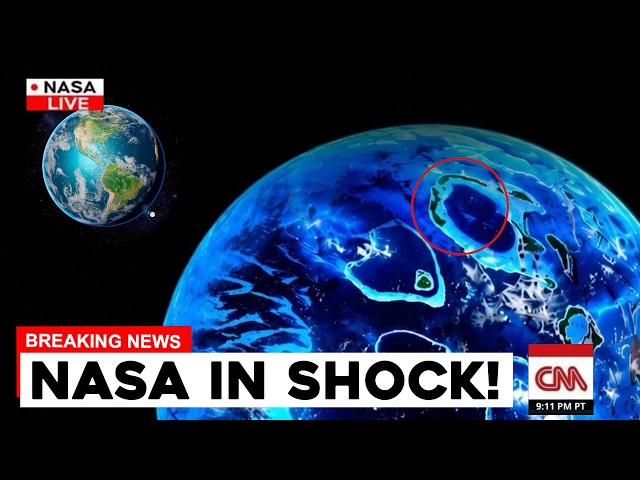
The planet is probably tidally locked, meaning one hemisphere always faces its star while the other remains in permanent darkness. Under some atmospheric scenarios, most of the surface would be frozen, but heat on the dayside could maintain a circular region of open water thousands of kilometers wide. From space, that configuration might resemble a giant dark pupil surrounded by bright ice—an “eyeball planet” with a permanent ocean centered beneath its sun.
This remains a model rather than an observed photograph. Webb cannot resolve continents, waves, islands, or the blue surface shown in dramatic online artwork. The accompanying image is therefore an imaginative visualization, not direct evidence of an Earth-like ocean. Scientists also have not discovered vegetation, animals, cities, or any biosignature on LHS 1140 b. Even the atmosphere’s existence and composition require further confirmation.
A recent Webb analysis found no helium absorption across four transits and suggested an earlier ground-based helium signal may have been spurious, although variable atmospheric escape cannot yet be excluded. Habitability depends on far more than a planet’s orbital location. Researchers must determine whether LHS 1140 b has retained a stable atmosphere, whether liquid water is genuinely present, how much radiation reaches the surface, and whether temperatures avoid both permanent freezing and a runaway greenhouse.
Detecting gases such as carbon dioxide would help distinguish between competing models, but the signals are extraordinarily small and may require many additional Webb observations. NASA describes LHS 1140 b as one of only a handful of small, potentially habitable worlds accessible to Webb’s atmospheric studies. The planet is not a confirmed second Earth, yet its possible combination of ice, ocean, and heavy atmosphere makes it one of the most compelling laboratories in the search for environments where life might exist.