The Sun Just Captured a Rogue Planet — And Scientists Can’t Explain It

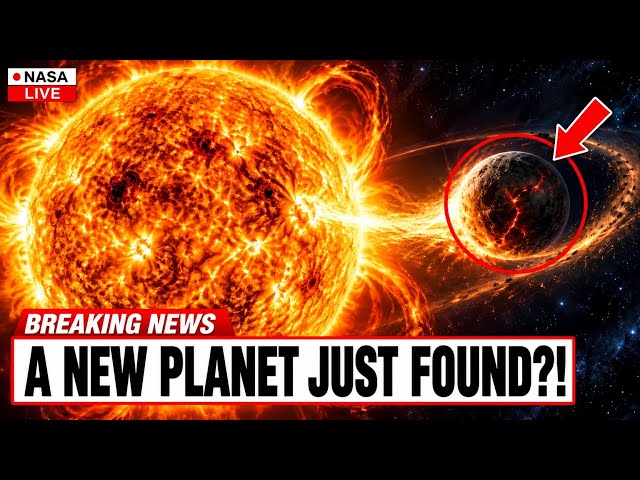
Astronomers are examining a remarkable theoretical possibility: under extremely rare conditions, the Sun could permanently capture a rogue planet wandering through interstellar space, transforming a homeless world into a distant member of our solar system. However, despite the dramatic headline and the fiery scene shown in the accompanying thumbnail, scientists have not announced the discovery of a new planet being captured near the Sun.
The image is an artistic composite, and any planet passing as close to the solar surface as depicted would face destructive heat, intense radiation and powerful tidal forces. The real science comes from research investigating whether an interstellar object could enter the Sun’s gravitational domain along a precise trajectory and remain trapped instead of simply accelerating past us.
A mathematical study by researchers Edward Belbruno and James Green describes a complex region of space in which the combined gravitational influence of the Sun and the Milky Way could theoretically produce permanent capture.
An incoming object entering this region at a sufficiently low relative speed might follow a chaotic path, repeatedly circling the Sun without escaping or colliding with it. Such an event would be extraordinarily difficult to observe and is expected to be rare. Rogue planets are worlds that travel through the galaxy without orbiting a parent star, possibly because they were violently ejected from young planetary systems or formed directly from collapsing clouds of gas.
NASA notes that Webb has identified hundreds of isolated brown-dwarf-like objects and planetary-mass candidates, demonstrating that starless worlds may be widespread throughout the Milky Way. If one passed through the outer solar system, the Sun alone would normally be unable to capture it because the object would gain speed while falling inward and then depart with nearly the same energy. A lasting capture would require gravitational interaction with another body, energy loss or the subtle influence of the galaxy over a very long period.
Some scientists have explored whether the hypothetical Planet Nine could be a captured rogue world, but simulations indicate that this scenario is highly improbable. More importantly, Planet Nine itself has never been directly observed. Its proposed existence is based on possible clustering in the orbits of distant Kuiper Belt objects, and NASA emphasizes that the scientific community continues to debate whether the planet is real. Astronomers searching for distant solar-system bodies rely on repeated observations to establish motion and calculate an orbit; a single glowing spot or unusual image cannot demonstrate that a planet has been captured. If researchers eventually identify a large object on a bound orbit with an unexpected chemical composition or trajectory, they could investigate whether it originated around another star.
Such a discovery would provide an unprecedented sample of alien planetary material and reveal how frequently star systems exchange worlds. For now, though, the “captured planet” remains a scientifically plausible scenario rather than a confirmed event. The Sun has not suddenly acquired a dangerous new companion, and no known rogue planet is approaching Earth—but the mathematics suggests that our solar system may be less isolated from the wandering population of the galaxy than scientists once assumed.