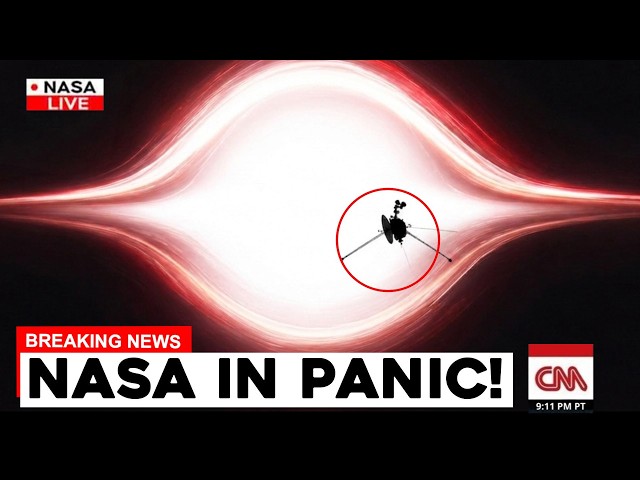
Voyager 1 Just Sent Back Something NASA Wasn’t Ready For

NASA’s Voyager 1 spacecraft has once again demonstrated its extraordinary resilience, returning valuable measurements from interstellar space nearly five decades after leaving Earth, but the latest transmission is not an image of a black hole or a mysterious cosmic object as sensational online graphics suggest. Voyager 1, launched in September 1977, is now the most distant human-made object and has been traveling through interstellar space since it crossed the heliopause in August 2012.
From this unexplored region, the spacecraft continues to transmit information about plasma waves and magnetic fields, giving scientists their only direct measurements of the environment beyond the protective bubble created by the Sun. NASA confirmed in April 2026 that these two remaining science instruments were still operating well and sending back data from a region no other functioning spacecraft has reached.
What engineers may not have been fully prepared for is not a terrifying object, but Voyager’s ability to keep functioning despite extreme distance, dwindling electrical power and technology designed in the 1970s. Every command sent from Earth must travel for almost an entire day before reaching the probe, and its reply requires nearly the same amount of time to return. Voyager 1 is expected to reach a distance of one light-day from Earth in November 2026, meaning a complete exchange of signals will take approximately 48 hours. The spacecraft’s three radioisotope thermoelectric generators lose power each year as their plutonium fuel naturally decays, forcing mission controllers to make increasingly difficult decisions about which heaters, instruments and subsystems can remain active.
In February 2026, NASA switched off Voyager 1’s low-energy charged-particle experiment to conserve electricity, leaving its plasma-wave instrument and magnetometer to continue the mission. This carefully planned shutdown was not evidence of panic; it was intended to extend the spacecraft’s scientific life for as long as possible. Engineers have repeatedly achieved results once considered unlikely, including restoring readable data after a flight-computer problem disrupted communications in late 2023 and reviving backup thrusters in 2025 that had been considered unusable since 2004.
The dramatic thumbnail accompanying the headline is therefore an artistic composite. Voyager 1 has not photographed itself approaching a black hole, and its cameras have not been used for scientific imaging since the famous “family portrait” of the solar system in 1990. Its modern transmissions consist of faint streams of numerical telemetry rather than spectacular photographs.
Yet the authentic story remains astonishing: a machine built before personal computers became common is still communicating across more than 15 billion miles of space, measuring a realm humanity has never visited and transforming an almost imperceptible radio signal into a scientific record from beyond the Sun’s frontier. NASA was not confronted by an impossible object—it was confronted by the remarkable endurance of its own creation.