An Object Larger Than Jupiter Is Near Earth’s Orbit—Scientists Are Investigating
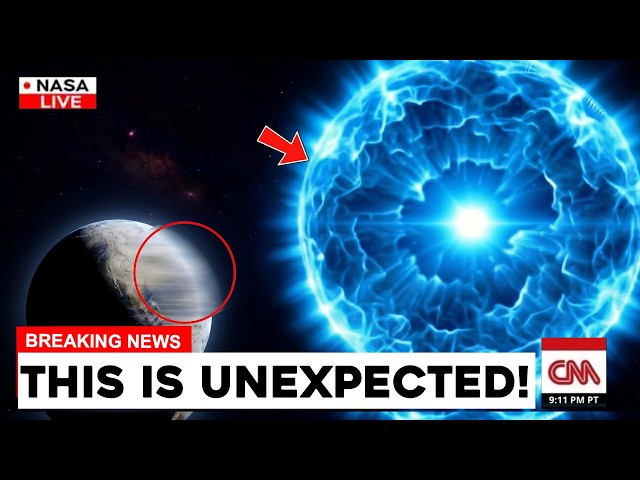
Astronomers are examining viral claims that an enormous unidentified object—reportedly larger than Jupiter—has appeared near Earth’s orbit, but current evidence does not support the existence of a new giant planet or similarly massive body in our immediate neighborhood. The speculation began after highly processed images showed a bright blue sphere or expanding structure positioned close to Earth. Researchers caution that an object’s apparent size in a two-dimensional image does not reveal its physical dimensions.
A nearby speck of dust, an optical reflection, a camera artifact or a diffuse cloud can look larger than a distant planet when distance and scale are unknown. Astronomical images are also frequently combined from multiple wavelengths and assigned artificial colors, making ordinary features appear unfamiliar or threatening. If a solid object physically larger than Jupiter had entered the inner solar system, its gravity would produce unmistakable changes in the motions of Earth, the Moon, nearby planets, spacecraft and asteroids.
Observatories around the world would detect it, and it would likely become one of the brightest objects in the sky. No such effects have been confirmed. Scientists investigating unusual detections therefore begin by checking raw data, comparing images from independent observatories and calculating whether the target moves consistently against background stars. They must also distinguish between a solid body and an extended phenomenon such as a comet’s coma, a cloud of gas, a solar eruption or an imaging artifact.
A comet may develop a cloud spanning hundreds of thousands of kilometers even though its nucleus is only a few kilometers wide; describing the entire cloud as an object “larger than Jupiter” would be technically dramatic but physically misleading. NASA’s Center for Near-Earth Object Studies defines near-Earth objects as asteroids and comets whose orbits bring them into Earth’s neighborhood—not giant planets or unknown stars.
The center uses continually updated observations to calculate trajectories and assess possible close approaches. Its automated Sentry system scans the asteroid catalog for potential Earth impacts over the next century and publishes credible risks after analysis. At present, there is no verified announcement from NASA or another major observatory confirming a Jupiter-sized object near Earth. The dramatic body shown in the accompanying thumbnail should therefore be treated as an illustration rather than an authentic telescope photograph. Investigators would need repeat observations, a measured distance, spectral data and a stable orbit before they could determine what any genuine detection represents.
The most likely explanations involve perspective, processed imagery or a diffuse natural event rather than a hidden world approaching Earth. Nevertheless, astronomers take unusual observations seriously because even far smaller asteroids can be scientifically important.
The investigation is not evidence of an impending catastrophe; it is the normal process through which extraordinary claims are tested. Until independent measurements establish a real object and calculate its dimensions, the phrase “larger than Jupiter” remains an unverified interpretation—not a confirmed danger in Earth’s orbit.