NASA Just Sent A New Telescope To Space — Here’s What It Would See (Nancy Grace Roman Space Telescope)
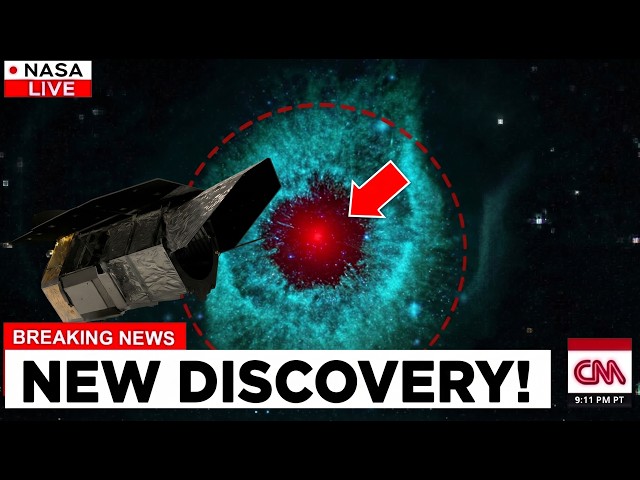
A new era of space exploration is approaching as NASA prepares to unleash one of the most powerful astronomical survey instruments ever developed: the Nancy Grace Roman Space Telescope. A dramatic image circulating online shows a futuristic telescope approaching a mysterious cosmic formation, where a brilliant red center appears surrounded by enormous turquoise clouds of glowing material. Accompanied by the announcement “NEW DISCOVERY!”, the image suggests that humanity may soon witness extraordinary structures hidden deep within the universe. But what will NASA’s next major space telescope actually discover, and could its observations reveal cosmic mysteries that even the James Webb Space Telescope cannot fully explain?
The Nancy Grace Roman Space Telescope represents a major advancement in humanity’s ability to investigate the universe on an enormous scale. Named after NASA’s first chief astronomer, who played a crucial role in the development of space-based astronomy, Roman is designed to study dark energy, distant galaxies, exoplanets, and the evolution of cosmic structures.
Unlike the James Webb Space Telescope, which specializes in exceptionally detailed observations of selected targets, Roman is designed to survey vast regions of the sky with remarkable efficiency.
Its primary mirror measures approximately 2.4 meters across, the same diameter as the Hubble Space Telescope’s main mirror.
However, Roman’s Wide Field Instrument will provide a field of view dramatically larger than Hubble’s infrared imaging capability.
This means Roman will be able to capture enormous areas of the cosmos while maintaining impressive image quality.
One of its most important scientific objectives is investigating dark energy, the mysterious phenomenon associated with the accelerating expansion of the universe.
Astronomers estimate that dark energy accounts for roughly 68 percent of the universe’s total mass-energy content.
Despite its enormous influence, scientists still do not fully understand its physical nature.
Roman will examine the distribution of galaxies across cosmic history, helping researchers measure how the universe expanded and how large-scale structures developed over billions of years.
By studying millions of galaxies, scientists hope to determine whether dark energy behaves like a constant property of space or changes over time.
Another major objective involves dark matter.
Although dark matter does not emit detectable light, its gravitational influence helps shape galaxies and enormous cosmic structures.
Roman will use gravitational lensing, the bending of light by gravity, to investigate the distribution of invisible matter.
By measuring subtle distortions in the shapes of distant galaxies, astronomers can reconstruct how matter is distributed across vast regions of space.
These observations could provide important tests of modern cosmological theories.
But Roman’s discoveries will not be limited to distant galaxies.
The telescope is also expected to revolutionize the search for planets beyond our solar system.
One particularly exciting technique is gravitational microlensing.
When a foreground star passes nearly in front of a more distant star, its gravity can temporarily magnify the background star’s light.
If the foreground star possesses planets, their gravitational influence may create additional changes in the observed brightness.
By monitoring enormous numbers of stars, Roman could discover thousands of exoplanets, including worlds that are difficult to detect using conventional transit methods.
Some may be relatively small planets orbiting far from their host stars.
Others could be free-floating planets traveling through the galaxy without orbiting any star.
These discoveries could dramatically improve our understanding of how planetary systems form and evolve.
Roman will also carry a Coronagraph Instrument designed to demonstrate advanced technologies for observing faint objects near bright stars.
Starlight normally overwhelms the reflected light from nearby planets, making direct imaging extremely challenging.
A coronagraph suppresses much of the star’s glare, potentially allowing astronomers to investigate faint planetary companions.
Although Roman’s coronagraph is primarily a technology demonstration, its achievements could help prepare the way for future missions designed to search for potentially habitable worlds.
The dramatic image accompanying the headline presents an intriguing cosmic structure resembling a glowing eye, with a brilliant red center surrounded by blue-green material.
Such imagery evokes planetary nebulae, energetic stellar environments, or other astronomical formations.
However, the supplied thumbnail does not establish that Roman has photographed this object or discovered an unknown cosmic phenomenon.
Its colors and composition appear illustrative, and astronomical images frequently use processed color representations to reveal features invisible to human eyes.
It is also important to distinguish between Roman’s scientific capabilities and claims that it has already made particular discoveries.
Roman’s mission has been planned around extensive sky surveys and observations that will take place after its launch and commissioning.
Specific claims of discoveries must therefore be supported by verified mission data rather than promotional illustrations.
One of Roman’s greatest strengths will be its ability to work alongside existing observatories.
James Webb can examine selected distant galaxies in extraordinary detail, while Roman can identify large populations of interesting targets across enormous regions of the sky.
Together, these telescopes could transform the study of the early universe.
Roman may reveal unusual galaxies, gravitationally lensed objects, and previously unknown planetary systems that researchers can investigate further with Webb and other instruments.
Its enormous datasets may also help scientists identify rare cosmic events that would otherwise remain unnoticed.
For example, observations of distant supernovae could improve measurements of cosmic expansion.
Studies of galaxy clustering could reveal how gravity and dark energy influenced the growth of structure throughout cosmic history.
And surveys of the Milky Way could uncover planetary populations that have remained largely invisible to previous telescopes.
Ultimately, Roman is not designed to replace James Webb but to complement it by providing an extraordinarily wide view of the universe.
Where Webb reveals remarkable detail, Roman will reveal the bigger picture.
The combination could allow astronomers to connect individual cosmic discoveries with the vast structures and processes shaping the universe as a whole.
As NASA advances toward Roman’s scientific operations, anticipation continues to grow over what its observations might reveal.
Perhaps it will uncover unexpected patterns in dark matter, new clues about dark energy, or entire populations of planets unlike anything scientists have previously detected.
The most exciting possibility is that Roman will discover something astronomers have not yet imagined.
What do you think? Will NASA’s Nancy Grace Roman Space Telescope make its greatest discovery by revealing the true nature of dark energy, uncovering hidden galaxies, or finding thousands of mysterious planets beyond our solar system? Could Roman and James Webb together completely transform humanity’s understanding of the universe? Share your thoughts in the comments!


