NASA Discovered a Star Moving at 56 Million MPH — How Is This Possible?

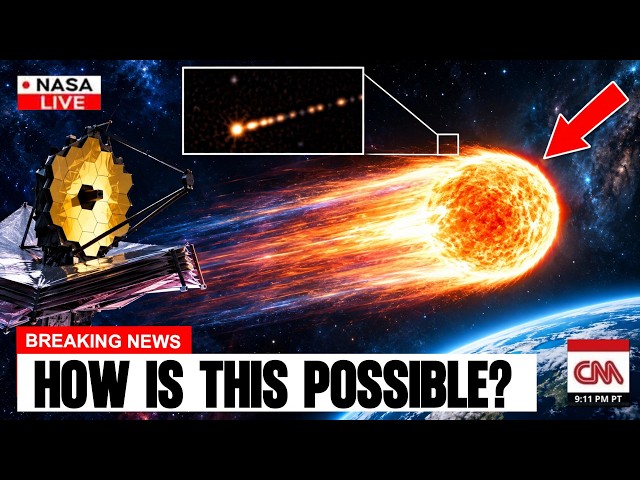
A mysterious object racing through space at an almost unimaginable speed has raised an extraordinary question: could a star really travel at 56 million miles per hour? A dramatic image circulating online shows NASA’s James Webb Space Telescope observing a blazing celestial object streaking across the cosmos, leaving behind an enormous trail of glowing material. An inset image reveals a series of bright points that appear to trace the object’s movement through space. Accompanied by the alarming question “HOW IS THIS POSSIBLE?”, the scene suggests that astronomers may have discovered something capable of challenging our understanding of gravity and cosmic motion. But has NASA really detected a star traveling at such an extreme velocity, and what could possibly accelerate an object containing an enormous amount of mass to that speed?
To understand the mystery, scientists must first consider the extraordinary speeds already observed throughout the universe.
Our Sun travels around the center of the Milky Way at approximately 500,000 miles per hour. Although this sounds incredibly fast, it is relatively ordinary compared with some of the most extreme objects astronomers have discovered.
Certain stars, known as hypervelocity stars, move fast enough to escape the gravitational pull of their home galaxies.
These stellar fugitives can reach speeds of millions of miles per hour, traveling through interstellar space on trajectories that may eventually carry them beyond the Milky Way.
One of the most fascinating mechanisms capable of producing such speeds involves supermassive black holes.
At the center of our galaxy lies Sagittarius A*, a black hole containing approximately four million times the mass of the Sun.
When a binary star system passes dangerously close to a supermassive black hole, intense gravitational forces can disrupt the pair.
One star may become gravitationally captured while the other is violently accelerated outward.
This process, known as the Hills mechanism, can launch stars through space at extraordinary velocities.
Astronomers have identified compelling examples of stars moving at exceptional speeds. One particularly remarkable object, S5-HVS1, was discovered traveling at roughly four million miles per hour and is believed to have been ejected from the vicinity of the Milky Way’s central black hole.
But 56 million miles per hour would be an entirely different level of motion.
That speed corresponds to approximately 25,000 kilometers per second, or more than eight percent of the speed of light.
For an ordinary star, such a velocity would be extraordinarily difficult to achieve through conventional gravitational interactions.
However, the universe contains objects that can move even faster.
In 2024, astronomers reported observations of a star associated with the supermassive black hole in galaxy M87 that appeared to be moving at an extraordinary apparent speed. Such observations require careful interpretation because astronomical images can contain features associated with jets, plasma, or other structures rather than entire stars traveling through space.
This distinction is crucial.
A bright object moving across astronomical images is not automatically a star, and an apparent motion does not always represent the physical movement of a solid celestial body.
Some of the fastest-moving material in the universe is found in relativistic jets launched from regions surrounding actively feeding black holes.
These jets contain highly energetic particles traveling at speeds approaching that of light.
When viewed from certain angles, their motion can even create an optical effect known as apparent superluminal motion, in which features seem to move faster than light without violating Einstein’s theory of relativity.
Another extreme example involves stars orbiting very close to supermassive black holes.
The star S2, which orbits Sagittarius A*, reaches approximately 17 million miles per hour near its closest approach to the black hole.
Its extraordinary speed provides scientists with a valuable opportunity to test Einstein’s predictions under intense gravitational conditions.
Although this is still far below 56 million miles per hour, it demonstrates that stars can achieve remarkable velocities when subjected to powerful gravitational forces.
The James Webb Space Telescope is helping astronomers investigate black holes, distant galaxies, and the violent environments surrounding rapidly growing cosmic structures.
Its infrared instruments can reveal objects obscured by dust and study galaxies from the earliest periods of cosmic history.
However, the supplied thumbnail does not establish that Webb or NASA has discovered an entire star moving at 56 million miles per hour.
The blazing object shown in the image resembles a cinematic illustration of a meteor or a stellar projectile. In reality, a star moving rapidly through the near-vacuum of interstellar space would not necessarily produce the enormous fiery trail depicted.
The series of bright points in the inset could represent repeated observations, a digitally created motion sequence, or another astronomical phenomenon. Without original observation data, it cannot be reliably identified.
Scientists would need precise measurements of distance, motion, and spectral properties before confirming an extraordinary stellar velocity.
If astronomers genuinely discovered a star traveling at 56 million miles per hour, the implications would be enormous.
Researchers would immediately investigate whether the object had experienced an extreme encounter with a supermassive black hole, originated from an unusual gravitational interaction, or represented a different kind of astrophysical phenomenon altogether.
Such a discovery could provide new information about the behavior of matter in the most extreme gravitational environments.
For now, the established scientific picture remains fascinating enough: stars can be violently expelled from galaxies, black holes can accelerate matter to relativistic speeds, and gravitational interactions can transform ordinary stellar systems into some of the fastest-moving objects in the cosmos.
The universe has not broken the laws of physics. Instead, its most extreme environments continue revealing just how extraordinary those laws can be.
And as telescopes become more powerful, astronomers may discover even faster stellar objects, offering unprecedented opportunities to investigate gravity, black holes, and the dynamic history of galaxies.
What do you think? If scientists discovered a star moving at 56 million miles per hour, would you suspect an encounter with a supermassive black hole, an unknown cosmic explosion, or an entirely new acceleration mechanism? Could the universe contain natural forces powerful enough to launch entire stars across galaxies at speeds we once thought impossible? Share your thoughts in the comments!