1 MINUTE AGO: Something Just Came Out of 3IATLAS
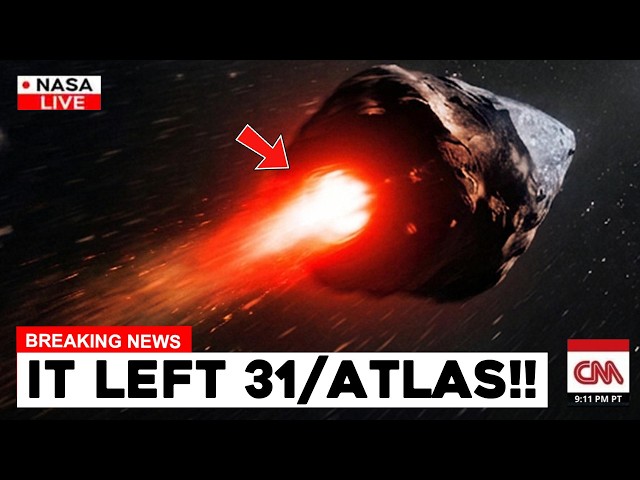
A mysterious burst of glowing material apparently emerging from the interstellar comet 3I/ATLAS has sparked extraordinary speculation about what might be happening inside one of the rarest visitors ever detected in our solar system. A dramatic image circulating online shows a massive, dark, rocky object surrounded by streaks of light, with an intense red-orange explosion erupting from what appears to be an opening in its surface. The accompanying headline claims that something has suddenly escaped from 3I/ATLAS, raising an unsettling question: Has the interstellar comet released an unknown object, or are astronomers witnessing a powerful natural process that could reveal the secrets of another planetary system?
Discovered in July 2025 by the ATLAS astronomical survey, 3I/ATLAS immediately attracted international scientific attention. Its unusual trajectory revealed that it was not an ordinary comet gravitationally bound to the Sun. Instead, it was traveling along a hyperbolic path, indicating that it originated beyond our solar system.
This made 3I/ATLAS only the third confirmed interstellar object ever discovered, following the mysterious 1I/’Oumuamua in 2017 and comet 2I/Borisov in 2019.
Unlike ordinary comets that formed within our solar system, interstellar visitors carry material from distant stellar environments. Scientists hope that studying their composition will reveal important information about how planets, asteroids, and comets form around other stars.
But the most intriguing feature of 3I/ATLAS is its cometary activity.
As a comet approaches the Sun, increasing solar radiation warms its surface. Frozen substances beneath or within the outer layers can transform directly into gas through a process known as sublimation.
This escaping gas can carry dust particles into space, creating an expanding atmosphere called a coma and, under suitable conditions, an enormous tail.
Occasionally, cometary activity becomes unusually intense.
A sudden release of gas and dust can produce a dramatic outburst, temporarily increasing a comet’s brightness and changing its appearance through telescopes.
Such events may occur when subsurface volatile materials become exposed, when fragile surface layers fracture, or when internal pressure disrupts portions of the comet’s crust.
To distant observers, an energetic outburst might resemble something suddenly emerging from the comet.
However, a burst of material does not necessarily mean that a solid object, spacecraft, or unknown life-form has escaped from its interior.
Comets are complex natural bodies, and their behavior can be surprisingly unpredictable.
Some have experienced fragmentation events in which their nuclei separated into multiple pieces. One well-known example is comet Shoemaker–Levy 9, which broke apart under Jupiter’s gravitational influence before its fragments collided with the planet in 1994.
Other comets have produced sudden increases in brightness when large quantities of material were expelled into surrounding space.
These events demonstrate that a comet can undergo dramatic physical changes without requiring any artificial explanation.
The possibility of fragmentation is especially interesting for interstellar objects because astronomers have limited opportunities to observe them.
If a fragment separated from 3I/ATLAS, researchers would need repeated observations to determine whether it was moving independently from the main nucleus.
They would also examine its brightness, trajectory, and possible surrounding dust cloud.
Such measurements could help distinguish a genuine solid fragment from a temporary concentration of dust or gas.
The image accompanying the viral headline, however, presents a much more sensational scenario.
Its glowing eruption resembles a powerful engine firing from inside a hollow asteroid, while the surrounding rocky shell appears almost mechanical.
Although visually striking, the thumbnail is not verified astronomical footage of an object launching from 3I/ATLAS. It should be treated as a dramatic illustration unless supported by original telescope data and independent scientific confirmation.
Real observations of distant comets rarely provide the detailed surface views shown in cinematic images.
Even powerful telescopes generally observe the combined light of the comet’s nucleus, coma, and surrounding dust rather than resolving small structures on its surface.
Another important consideration involves the headline’s claim that the event occurred “1 MINUTE AGO.”
Such timestamps are common in sensational online videos, but they do not establish when an astronomical observation was recorded.
Authentic discoveries require documented observation times, instrument information, and measurements that other researchers can examine.
Scientists studying 3I/ATLAS are particularly interested in its chemical composition.
By analyzing light emitted or absorbed by material surrounding the comet, astronomers can investigate the presence of gases, dust, and other substances associated with its formation.
These observations may help researchers compare the chemistry of distant planetary systems with that of our own.
If 3I/ATLAS displays unusual activity, the most scientifically productive response is to investigate the physical mechanisms responsible rather than immediately assuming an extraterrestrial technological origin.
After all, the comet’s existence is already remarkable.
It traveled through interstellar space before entering our solar system, carrying material that may have formed around a star completely different from the Sun.
Every observation offers an opportunity to learn about environments that spacecraft have never visited.
Ultimately, there is no verified evidence from the supplied image that an artificial object emerged from 3I/ATLAS or that the comet contains hidden extraterrestrial technology.
Natural outgassing, dust release, and possible fragmentation provide scientifically grounded explanations for apparent changes in a comet’s appearance.
Yet the broader mystery remains fascinating: what can this ancient interstellar traveler reveal about the distant region of the galaxy where it formed?
As astronomers continue analyzing interstellar objects, future discoveries may reveal unexpected chemical compositions, unusual physical structures, or previously unknown details about how planetary systems evolve.
And sometimes, the most extraordinary discoveries are not hidden spacecraft or alien machines, but natural processes that scientists have never had the opportunity to observe before.
What do you think? If astronomers genuinely detected a separate object emerging from 3I/ATLAS, would you suspect a natural comet fragment, an unusual eruption of frozen material, or something that challenges our understanding of interstellar visitors? Could an object traveling between the stars still be hiding surprises that humanity has never encountered? Share your thoughts in the comments!