James Webb Is Over! It Just Found A Star Made Of A Black Hole — And It Shouldn’t Exist
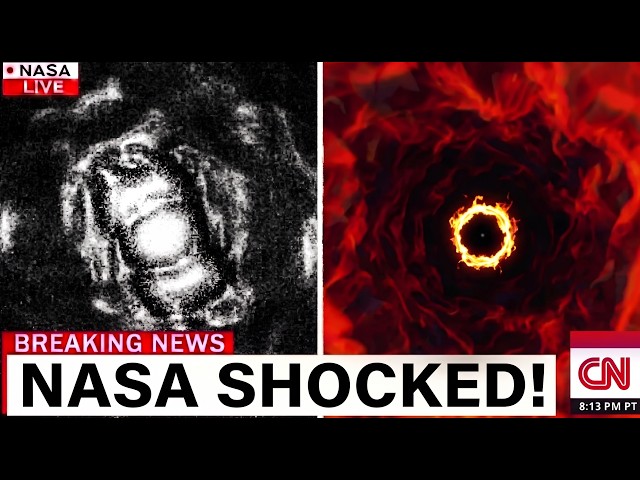
A mysterious cosmic object surrounded by swirling darkness and a brilliant ring of fire has reignited one of the most extraordinary questions in modern astronomy: Could the universe contain stars powered by black holes instead of nuclear fusion? A dramatic image circulating online shows a strange, luminous formation resembling a star with an enormous black hole at its center. Accompanied by the alarming announcement “NASA SHOCKED!”, the image suggests that the James Webb Space Telescope may have discovered something that challenges our understanding of stellar evolution. Although there is no confirmed evidence that Webb has photographed the exact object depicted, the scientific idea behind this mystery is surprisingly real—and astronomers have been investigating it for years.
Ordinary stars, including our Sun, generate energy through nuclear fusion. Deep inside their cores, hydrogen nuclei combine to form helium, releasing enormous amounts of energy that counteract gravitational collapse.
Black holes operate very differently.
They are regions of spacetime where gravity becomes so intense that nothing, not even light, can escape from within the event horizon.
But what would happen if a black hole existed inside an enormous envelope of gas resembling a star?
Scientists have proposed a fascinating hypothetical class of objects known as quasi-stars.
Unlike conventional stars, quasi-stars would not rely primarily on nuclear fusion to produce their enormous luminosity.
Instead, they could be powered by material falling toward a black hole buried deep within their interiors.
As gas spiraled inward, gravitational energy would be converted into heat and radiation, potentially supporting a vast surrounding envelope against collapse.
The result could resemble an extraordinarily massive star, even though its central energy source was a growing black hole.
Some theoretical models suggest that quasi-stars might have existed during the universe’s earliest stages, when enormous quantities of primordial gas were available.
These objects could help explain one of astronomy’s greatest mysteries: how supermassive black holes formed so quickly after the Big Bang.
Astronomers have discovered extremely distant quasars powered by black holes containing hundreds of millions or billions of solar masses.
Some existed when the universe was less than a billion years old.
Their existence presents an important challenge because black holes require time to accumulate mass.
If the first black holes formed only from the remnants of ordinary massive stars, some would need to grow exceptionally rapidly to reach the enormous masses observed in the early universe.
Quasi-stars offer one possible explanation.
A massive gas cloud might collapse, forming a black hole embedded within a much larger gaseous structure.
The central black hole could then consume surrounding material while the outer envelope temporarily remained intact.
This environment might allow unusually rapid black hole growth under certain conditions.
Eventually, the envelope could disperse, leaving behind a massive black hole capable of developing into the engine of a bright quasar.
However, quasi-stars remain hypothetical objects, and astronomers have not conclusively confirmed the existence of one.
This is where the James Webb Space Telescope becomes particularly important.
Webb’s infrared instruments allow scientists to investigate distant galaxies and energetic objects from the universe’s earliest periods.
Its observations have revealed surprisingly bright and compact sources, including a mysterious population known as Little Red Dots.
Some of these objects exhibit spectral features suggesting that they contain actively growing black holes.
Researchers are investigating whether certain early black holes formed from massive seeds rather than exclusively from ordinary stellar remnants.
Such discoveries could provide valuable clues about the processes that created the universe’s first supermassive black holes.
But detecting an early black hole does not automatically mean astronomers have discovered a quasi-star.
Scientists must distinguish between several possibilities, including compact galaxies, dust-obscured active galactic nuclei, unusual stellar populations, and hypothetical black-hole-powered objects.
To investigate these alternatives, researchers analyze the spectrum of light emitted by distant sources.
Different gases produce characteristic emission and absorption features, allowing scientists to estimate chemical composition, temperature, motion, and other physical properties.
Broad emission lines may indicate rapidly moving gas near an actively feeding black hole.
Meanwhile, the overall distribution of radiation can help researchers determine whether an object’s energy originates primarily from stars or black hole accretion.
The dramatic thumbnail accompanying the headline presents an enormous glowing ring surrounding a dark central region.
Although visually striking, the image is not verified evidence that Webb has discovered a star literally made of a black hole.
A black hole is not a material from which a star can be constructed.
Rather, the scientific concept involves a black hole potentially powering a surrounding gaseous envelope.
The fiery circular appearance also resembles artistic representations of black hole accretion disks, where intensely heated material produces powerful radiation.
Such images are often created using computer simulations or digital illustrations rather than direct telescope photography.
Another important distinction involves the claim that this discovery would make James Webb obsolete.
In reality, Webb is one of the instruments best suited to investigating these mysteries.
Its ability to observe ancient galaxies and analyze infrared spectra provides astronomers with information that previous generations of telescopes could not obtain as effectively.
Rather than ending Webb’s scientific importance, the search for quasi-stars and massive black hole seeds highlights why its observations are so valuable.
Ultimately, NASA has not confirmed that James Webb has discovered a quasi-star or a black-hole-powered star that violates the laws of physics.
What scientists are genuinely exploring is whether the early universe contained extraordinary objects unlike the stars we observe today.
If quasi-stars are eventually confirmed, they could reveal a previously unknown stage in the evolution of massive black holes.
Such a discovery might explain how enormous black holes appeared so early in cosmic history and transform our understanding of the first galaxies.
The most remarkable possibility is that the universe once contained objects that looked like stars but were powered by the gravitational energy of black holes hidden deep inside them.
What do you think? Could black holes have existed inside gigantic star-like structures billions of years ago? And if James Webb eventually discovers a genuine quasi-star, would it solve the mystery of how supermassive black holes formed so quickly after the Big Bang? Share your thoughts in the comments!