Nobel Prize Winner: “There Was a Universe Before Ours” – And James Webb Just Prove It
A fascinating theory about the origin of our universe is attracting renewed attention as scientists investigate whether the Big Bang truly marked the beginning of everything. The idea that another universe may have existed before ours sounds like science fiction, yet it has been explored by some of the world’s most respected physicists. Among them is Nobel Prize-winning scientist Sir Roger Penrose, whose controversial cosmological theory suggests that the universe could be part of an extraordinary cycle of cosmic beginnings and endings. Meanwhile, observations from NASA’s James Webb Space Telescope are revealing surprisingly complex galaxies in the early universe, raising new questions about how cosmic structures formed. But has Webb actually discovered evidence of a universe that existed before the Big Bang?
According to the standard cosmological model, our observable universe evolved from an extremely hot, dense state approximately 13.8 billion years ago. As space expanded and cooled, particles formed atoms, gravity gathered matter into enormous structures, and the first stars and galaxies eventually appeared.
However, an important mystery remains: what, if anything, existed before this early hot phase?
Penrose has proposed a remarkable possibility known as Conformal Cyclic Cosmology, or CCC.
Under this theory, the universe does not necessarily experience only one beginning. Instead, cosmic history could consist of successive periods called aeons, each representing an entire universe-like era.
In this model, the unimaginably distant future of one aeon may be mathematically connected to the beginning of the next.
The concept challenges the familiar picture of a single cosmic beginning.
Rather than emerging from absolute nothingness, our universe might have developed from conditions associated with a previous cosmic era.
Supporters of the theory have investigated whether traces of earlier aeons could survive in the cosmic microwave background, the ancient radiation left over from the early universe.
Some proposed signatures include unusual circular patterns or localized features that might reflect processes occurring before our aeon began.
However, these interpretations remain controversial, and researchers have not established that such patterns provide convincing evidence of a previous universe.
This is where the James Webb Space Telescope enters the discussion.
Since beginning scientific observations in 2022, Webb has transformed astronomers’ understanding of the early cosmos.
Its powerful infrared instruments allow scientists to observe extremely distant galaxies whose light has traveled through space for more than 13 billion years.
Some early galaxies appear unexpectedly bright, chemically developed, or structurally complex, prompting researchers to reconsider aspects of galaxy formation.
These observations are important because astronomers must explain how stars and galaxies developed so rapidly after the Big Bang.
Yet Webb has not proved that another universe existed before ours, nor has it confirmed Penrose’s cyclic cosmology theory.
The telescope observes light from distant astronomical objects within our universe. It cannot directly photograph an earlier universe or look beyond the observable limits of cosmic history.
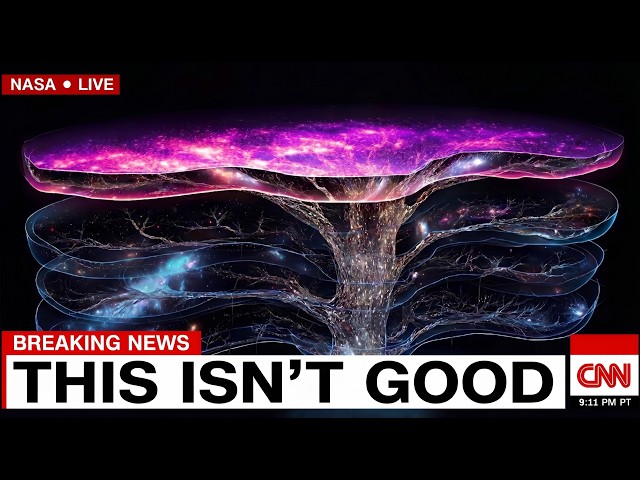
The dramatic image accompanying the headline depicts several glowing cosmic layers connected by a central structure, suggesting multiple universes stacked together.
Although visually striking, this should be understood as a conceptual illustration rather than an authentic James Webb photograph of parallel or previous universes.
Scientists continue exploring alternative cosmological models, including cyclic universes, cosmic bounces, and theories involving periods of expansion and contraction.
Some models suggest that a previous cosmic phase could have preceded the hot Big Bang, potentially avoiding the need for an absolute beginning of time.
Others investigate whether quantum gravitational effects might have influenced the universe’s earliest moments.
These ideas remain subjects of active theoretical research rather than established discoveries.
Future observations could help scientists distinguish between competing explanations.
More precise measurements of the cosmic microwave background, gravitational waves, and the distribution of galaxies may reveal information about physical processes that occurred extremely early in cosmic history.
Webb’s discoveries are already helping researchers refine models of star formation, black hole growth, and galaxy evolution.
But evidence that galaxies formed earlier than expected does not automatically overturn the Big Bang model.
Instead, it may reveal that some details of early cosmic evolution were more complicated than previously understood.
The distinction is crucial.
Scientific breakthroughs often begin when observations challenge existing predictions, but extraordinary conclusions require strong, independently verified evidence.
For now, the possibility of a universe before ours remains one of cosmology’s most intriguing unanswered questions.
If Penrose’s theory were eventually supported by compelling observations, it could fundamentally change humanity’s understanding of time, cosmic origins, and the ultimate fate of existence.
The universe might not be a single story with one beginning and one ending, but part of a much larger sequence extending beyond anything we can currently observe.
Until that evidence emerges, the James Webb Space Telescope continues revealing the extraordinary history of the universe we inhabit.
And perhaps the most fascinating possibility is that understanding our cosmic past may eventually help scientists determine whether the Big Bang was truly the beginning—or simply the beginning of the chapter we can see.
What do you think? Did our universe begin with the Big Bang, or could another universe have existed billions upon billions of years before ours? If scientists discovered convincing evidence of a previous cosmic era, would it completely change how you understand reality? Share your thoughts in the comments!