“They’re Coming Out of the Ocean Over New Jersey”? Viral Video Makes a Dramatic Claim, but Nothing Is Confirmed
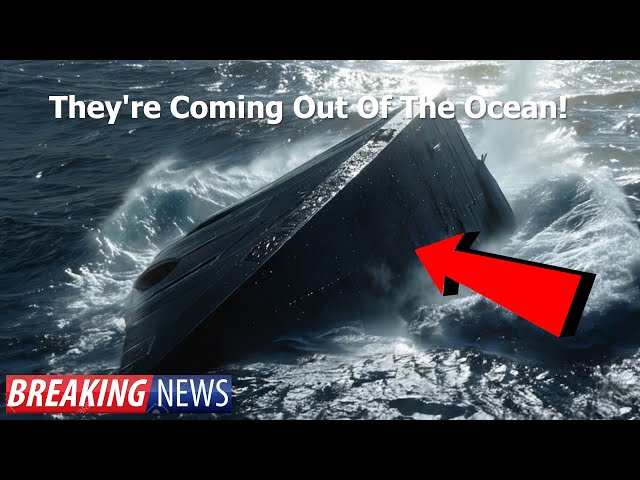
A video titled “BREAKING UFO NEWS! They’re Coming Out Of The Ocean Over New Jersey!” is circulating online, led by a thumbnail of an enormous dark object rising from stormy seas. A bold red arrow points at the object, overlay text repeats the claim that “they” are emerging from the water, and a “Breaking News” banner sits in the corner. The title suggests that unidentified craft are leaving the ocean near New Jersey. No official agency, military branch, coast guard unit, or established news organization has been identified as confirming any such event.

What the thumbnail shows
The image presents a huge, angular, dark-gray structure tilting out of rough water. Its flat panels and sharp edges recall the bow of a ship or a submarine more than a traditional flying saucer. White foam and spray crash against its sides, and the surrounding waves are choppy and cold-looking. The sky is not visible, and the framing is tight, so the viewer cannot judge the object’s true size.
What the image does not show is just as telling. There is no coastline, no boat, no aircraft, no person, and no landmark. Nothing in the frame identifies a place, and nothing ties the scene to New Jersey. The thumbnail shows one object, while the text speaks of “they,” so the picture and the wording do not clearly match. Nor does anything in the image show that the object is flying, which sits oddly beside the “UFO” label in the title.
Signs the imagery may not be real
Several features suggest the picture was created digitally rather than photographed. The water has the highly detailed, evenly lit look of rendered or AI-generated art, the object’s surface is unusually clean and geometric, and the composition is dramatic and cinematic, as if designed for a film poster. Real photographs of large objects in rough seas usually include signs of scale, such as ships, aircraft, or coastline, and are often blurred by spray and motion.
None of this proves what the video itself contains, since thumbnails are often made separately from the footage. But it does mean the image should not be treated as evidence that anything emerged from the ocean.
“Coming out of the ocean”: a familiar idea
The notion of unidentified objects entering or leaving the sea has a long history in UFO literature. Such objects are often described under the label “USO,” or unidentified submerged object. Over the years, witness reports from sailors, pilots, and coastal residents have described lights or shapes moving between air and water. These accounts have rarely been backed by recordings, sensor data, or physical evidence that scientists can examine, and the topic remains largely in the realm of anecdote.
The idea also resonates with popular fiction, where hidden bases beneath the sea and craft rising from the waves are common story elements. That familiarity makes such images easy to produce and easy for audiences to accept, which helps explain their appeal in clickbait.
The New Jersey connection
The mention of New Jersey will remind many readers of the widespread reports of unexplained drones in the northeastern United States in late 2024. Those sightings drew heavy media coverage and public concern. Officials said at the time that many of the reported objects turned out to be ordinary aircraft, hobby and commercial drones, and other known objects, although the episode raised real questions about airspace monitoring and public communication.
That history helps explain why a title using this location attracts attention. Creators know that audiences associate New Jersey with aerial mysteries, and a place name makes a claim feel closer to home. It does not, however, show that this video has any connection to the earlier reports.
What a real event would leave behind
If large unknown objects truly emerged from the sea off a densely populated coast, the evidence would be overwhelming. Coast guard and naval records would show alerts and responses. Ships, fishing boats, and offshore platforms would report what they saw. Beachgoers, residents, and drivers along the shore would post footage from many angles. Radar operators, air traffic controllers, and weather services would hold data. Local broadcasters would send crews, and national and international media would cover the story within hours.
The title promises breaking news, yet no independent trail of this kind has been identified. In a region where almost everyone carries a camera, the absence of corroboration is itself informative.
The anatomy of a clickbait package
The thumbnail relies on a familiar formula:
- A news-style banner that suggests a real broadcast, though anyone can add one
- A giant red arrow that implies something important is hidden in the image
- Overlay text that repeats the boldest claim in the most dramatic terms
- A plural pronoun (“they”) that implies a large, coordinated event without describing it
- A real-world location that gives the claim a veneer of credibility
These elements are effective because they trigger fast emotional reactions. They are also easy to reproduce, and AI image tools now make it possible to produce a convincing scene in minutes. A viewer cannot tell from a thumbnail alone whether the underlying video shows a genuine event, a staged clip, a video game capture, a fictional production, or recycled footage from elsewhere.
Ordinary explanations worth considering
Strange sights over and on the water often have mundane causes. Ships, submarines surfacing, offshore wind and drilling structures, floating debris, and large waves can all look unusual from a distance or through a phone camera. Fog, spray, and glare can distort shapes, and cloud formations near the horizon can resemble solid objects. Aircraft, drones, flares, and meteors can add to the confusion at night. None of these explanations applies to every case, but they show why careful analysis is needed before reaching extraordinary conclusions.
How to check a claim like this
Media-literacy specialists suggest a straightforward process:
- Look for specifics. Does the video name a place, a date, and a source?
- Search for independent coverage. Check New Jersey news outlets, coast guard and local authority announcements, and official statements from aviation or defense agencies.
- Reverse-search the image. Tools that trace image origins can reveal whether a picture comes from an AI gallery, a game, or a film.
- Compare the thumbnail with the footage. Does the video actually show an object leaving the water, or only a teaser image?
- Check the channel. Does it have a record of verified reporting, or mainly sensational titles?
Why this content spreads
Curiosity about the unknown is powerful, and a looming shape in stormy water, a familiar place name, and an urgent headline make an almost perfect click magnet. Platforms reward strong reactions, so each comment, share, and debate helps the video travel, regardless of accuracy. There is also a cost. Exaggerated or fabricated videos can spread unnecessary alarm, distract from genuine public-safety information, and make it harder for audiences to take well-documented cases seriously.
The bottom line
As it stands, there is no verified evidence that unidentified craft are coming out of the ocean over New Jersey. The thumbnail appears to be a digitally created image, nothing in it points to the location named in the title, and no credible source has backed up the claim.
Unidentified aerial and submerged phenomena remain a legitimate subject of study, and unexplained reports deserve careful, evidence-based investigation. But that work depends on data, not dramatic artwork. Until reliable reporting, official statements, or verifiable original footage emerge, this story is best treated as a viral curiosity: striking to look at, impossible to confirm, and a reminder to ask who made an image, and why, before believing it.