“UFO Invasion Over Our World? Something Strange Is Happening!” Viral Video Raises Alarm, but Nothing Is Confirmed
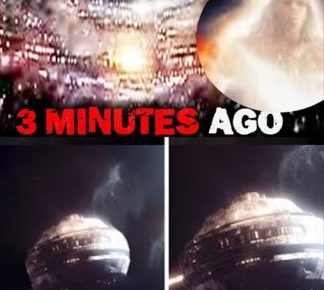
A video titled “BREAKING NEWS! UFO INVASION Over Our World? SOMETHING Strange Is Happening!” is circulating online, led by a thumbnail of a vast, disc-shaped craft hovering above a quiet neighborhood at night. A bold red arrow points at the object, and a “Breaking News” banner sits in the corner. The title suggests a global “invasion” and hints that something unexplained is unfolding. It offers no location, no date, and no source, and no official agency or established news organization has been identified as confirming any such event.

What the thumbnail shows
The image presents a large, polished, saucer-shaped craft with a domed top and a tapering underside. Rows of small white lights dot its hull, and a narrow beam of pale light points straight down from its center. The sky behind it is deep blue and scattered with stars. In the foreground, the dark silhouettes of two houses and several trees frame the scene, so the viewer seems to be looking up from a residential street.
What the image does not show is just as telling. There are no people, no vehicles, no one filming, and no landmarks. Nothing in the frame identifies a place, and nothing suggests more than one craft, which sits oddly beside the word “invasion.” A single disc over a single neighborhood does not amount to a worldwide event.
Signs the imagery may not be real
Several features suggest the picture was created digitally rather than photographed. The craft’s surface is crisp and evenly lit despite the darkness, the lights are arranged in neat, symmetrical patterns, and the composition resembles a film poster, with the object perfectly centered and framed by rooftops and trees. Real nighttime photographs of distant objects are typically grainy, blurry, and unevenly lit, and they rarely look this clean.
None of this proves what the video itself contains, since thumbnails are often made separately from the footage. But it does mean the image should not be treated as evidence of a real sighting.
The language of “invasion”
The word “invasion” is among the most powerful in the genre. It evokes decades of science-fiction films and radio dramas, and it triggers an immediate emotional response. Paired with the question mark and the vague line “something strange is happening,” the title creates suspense without committing to anything that can be checked.
That vagueness is a feature of the format. A question allows a creator to hint at a dramatic story without making a specific claim, and viewers are left to fill the gap with their own fears or hopes. The phrase “over our world” widens the scope even further, implying a global event without naming a single country, city, or witness.
What a real global event would look like
If unidentified craft were truly appearing over many parts of the world, the evidence would be impossible to miss. Governments would issue statements, aviation authorities would report disruptions, and militaries would raise alert levels. Radar and satellite data would show unusual tracks. Millions of people across different time zones would post footage, and news organizations on every continent would run continuous coverage. Scientists and independent analysts would be examining the data in public.
The title promises breaking news, yet no independent trail of this kind has been identified. In a world where billions of people carry cameras, the absence of corroboration is itself informative.
Official interest and popular excitement
The broader topic of unidentified aerial phenomena (UAP) has received more serious attention in recent years. Government bodies in several countries have held discussions and issued reports, which has made public conversation more open than it once was. That shift helps explain why videos like this one find a large audience.
But official interest in the subject is not the same as official confirmation of any particular viral claim. Investigators work through formal channels, and their findings appear in reports and data releases, not in thumbnails. So far, there is no sign that any agency has confirmed an “invasion” or anything resembling it.
The anatomy of a clickbait package
The thumbnail relies on a familiar formula:
- A news-style banner that suggests a real broadcast, though anyone can add one
- A giant red arrow that implies something important is hidden in the image
- Alarming keywords such as “invasion” and “something strange,” built for urgency
- A closing question that creates suspense without making a checkable claim
- A dramatic night scene that adds mood and fear
These elements are effective because they trigger fast emotional reactions. They are also easy to reproduce, and AI image tools now make it possible to produce a convincing scene in minutes. A viewer cannot tell from a thumbnail alone whether the underlying video shows a genuine event, a staged clip, a video game capture, a fictional production, or recycled footage from elsewhere.
Ordinary explanations worth considering
Even real footage of lights in the night sky is often misunderstood. Aircraft, helicopters, drones, balloons, satellites, and the growing number of satellite constellations can produce strange visuals, especially when filmed through a phone camera. Lens flare, reflections, and long exposures can create glowing shapes and beams. These explanations do not apply to every case, and some reports remain unresolved, but they show why careful analysis is needed before reaching extraordinary conclusions.
How to check a claim like this
Media-literacy specialists suggest a straightforward process:
- Look for specifics. Does the video name a place, a date, and a source?
- Search for independent coverage. Check established news outlets and official agency websites.
- Reverse-search the image. Tools that trace image origins can reveal whether a picture comes from an AI gallery, a game, or a film.
- Compare the thumbnail with the footage. Does the video actually show a craft, or only a teaser image?
- Check the channel. Does it have a record of verified reporting, or mainly sensational titles?
Why this content spreads
Curiosity and fear are powerful, and a glowing craft, an urgent headline, and the promise of a world-changing secret make an almost perfect click magnet. Platforms reward strong reactions, so each comment, share, and debate helps the video travel, regardless of accuracy. There is also a cost. Exaggerated or fabricated videos can spread unnecessary alarm, especially among people who take dramatic headlines at face value, and make it harder for audiences to take well-documented cases seriously.
The bottom line
As it stands, there is no verified evidence of a UFO invasion, and no confirmation that anything unusual is happening on a global scale. The thumbnail appears to be a digitally created image, the title offers no checkable details, and no credible source has backed up its claim.
Unidentified aerial phenomena remain a legitimate subject of study, and unexplained reports deserve careful, evidence-based investigation. But that work depends on data, not dramatic artwork. Until reliable reporting, official statements, or verifiable original footage emerge, this story is best treated as a viral curiosity: striking to look at, impossible to confirm, and a reminder to ask who made an image, and why, before believing it.