James Webb Just Spent 100 Hours Looking at Proxima Centauri — What It Found Is Mind-Blowing
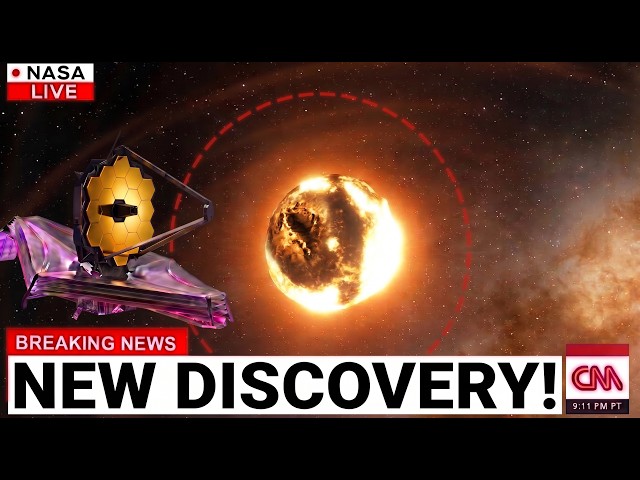
A sensational claim involving NASA’s James Webb Space Telescope has reignited excitement about one of the most fascinating destinations beyond our solar system: Proxima Centauri, the closest known star to the Sun. Located approximately 4.24 light-years from Earth, this small red dwarf has attracted extraordinary scientific interest because at least one confirmed planet, Proxima Centauri b, orbits within its star’s potential habitable zone. A dramatic image circulating online appears to show the James Webb Space Telescope observing a glowing, partially molten planet surrounded by intense radiation. The headline suggests that Webb spent 100 hours investigating the system and uncovered an astonishing discovery. However, there is no independently verified evidence establishing the specific 100-hour observation or confirming that Webb discovered a burning planet resembling the dramatic thumbnail.
Proxima Centauri is an extraordinary astronomical target because it represents humanity’s nearest opportunity to investigate a planetary system beyond our own. Despite its proximity, the star is too faint to see with the naked eye. It belongs to the red dwarf category, meaning it is significantly smaller, cooler, and less luminous than the Sun. Its most famous planet, Proxima Centauri b, was announced in 2016 after astronomers detected subtle changes in the star’s motion caused by the planet’s gravitational influence.
The discovery immediately attracted attention because Proxima Centauri b has a minimum mass comparable to Earth’s and completes an orbit approximately every 11.2 days. Although this orbit is much closer to its star than Earth’s orbit around the Sun, Proxima Centauri produces considerably less energy than our star. Consequently, the planet receives an amount of stellar radiation that makes the possibility of liquid water scientifically interesting.
However, being located within a habitable zone does not mean a planet is necessarily habitable. The existence of surface water depends on atmospheric pressure, temperature, chemical composition, and numerous other environmental factors.
One of the greatest mysteries surrounding Proxima Centauri b involves the behavior of its parent star. Red dwarfs can produce powerful stellar flares that release intense ultraviolet and X-ray radiation. Proxima Centauri is particularly active, occasionally generating energetic outbursts that could significantly affect nearby planetary atmospheres.
Scientists are investigating whether a planet exposed to such activity could retain enough atmosphere to support stable surface conditions. Some theoretical models suggest that strong stellar radiation might gradually strip away atmospheric gases, while others explore whether magnetic fields, atmospheric replenishment, or protective environmental conditions could help a planet survive.
This is where the James Webb Space Telescope becomes especially important.
Webb’s infrared instruments are designed to investigate planetary atmospheres, distant galaxies, and the chemical processes occurring throughout the universe. By examining infrared radiation, astronomers can search for molecular signatures and investigate how stars interact with surrounding planetary environments.
Nevertheless, observing Proxima Centauri b presents exceptional difficulties. The planet has not been established as a transiting world from Earth’s perspective, preventing astronomers from using the straightforward transmission-spectroscopy techniques applied to many other exoplanets. Its close angular separation from its bright host star also makes direct observation extremely challenging.
Even with Webb’s extraordinary capabilities, separating the faint signal of a small rocky planet from the radiation of its parent star requires sophisticated observational methods and careful analysis.
The sensational image accompanying the viral headline depicts an enormous glowing planetary body with a brilliant illuminated surface, suggesting a world undergoing catastrophic heating. Some viewers might interpret this as evidence that Webb discovered a planet being destroyed by stellar radiation.
However, the image is not authenticated as an actual James Webb observation of Proxima Centauri b. It appears to be an artistic visualization rather than a scientifically verified photograph.
The telescope has not confirmed that Proxima Centauri b possesses oceans of molten rock, a collapsing atmosphere, or visible planetary destruction resembling the thumbnail.
The real scientific mystery is arguably more fascinating: could an Earth-sized planet survive for billions of years around an active red dwarf?
Answering this question could transform our understanding of habitability across the galaxy. Red dwarfs are among the most common stars in the Milky Way, and many are known to host planetary systems. If rocky planets around these stars can maintain stable environments, the number of potentially habitable worlds could be enormous.
Future observations using advanced space telescopes and extremely large ground-based observatories may help researchers investigate the composition and environmental conditions of nearby exoplanets.
Proxima Centauri remains particularly important because its relative proximity makes it a natural target for future scientific exploration and ambitious concepts involving interstellar probes.
Ultimately, the James Webb Space Telescope has revolutionized exoplanet research, but the claim that it spent exactly 100 hours observing Proxima Centauri and discovered the fiery world shown in the thumbnail remains unverified. The confirmed discoveries surrounding this neighboring star are already extraordinary, revealing that planetary systems exist even around the closest stars to Earth.
Perhaps the greatest question is not whether Proxima Centauri hides a burning planet, but whether one of humanity’s nearest planetary neighbors could possess conditions suitable for life.
What do you think? If future observations revealed that Proxima Centauri b has a stable atmosphere and possibly liquid water, would you believe humanity had discovered its closest potentially habitable world, or could the star’s violent radiation make life there impossible? Share your thoughts in the comments!