The 31 Heroes That Were Sacrificed To Make Artemis II Possible

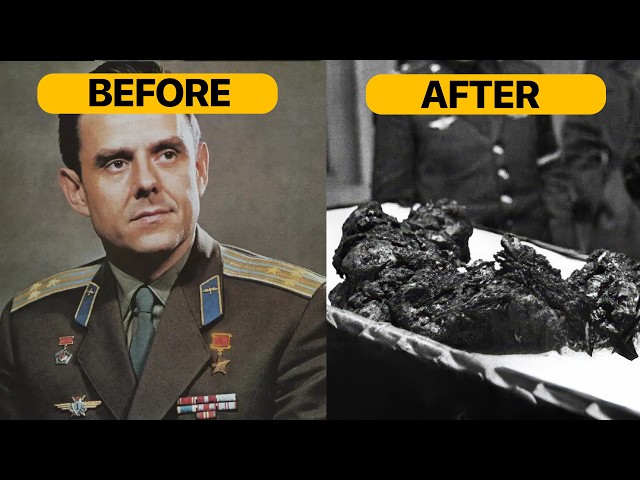
Behind humanity’s ambitious return to the Moon lies a history marked not only by extraordinary scientific achievements but also by devastating tragedies that permanently changed the future of space exploration. As NASA advances its Artemis program, renewed attention has turned toward the astronauts, cosmonauts, and test pilots whose deaths exposed the dangers of human spaceflight. A haunting image circulating online shows a Soviet-era space officer beside what appears to be severely burned human remains, accompanied by the disturbing claim that 31 heroes were sacrificed to make Artemis II possible. The imagery raises an emotional question: How many lives were lost before humanity developed the technology and safety procedures required to send astronauts around the Moon again? Although the headline uses dramatic language, the history behind it contains genuine tragedies that continue to influence spacecraft engineering today.
One of the earliest and most disturbing disasters occurred on March 23, 1961, when Soviet cosmonaut trainee Valentin Bondarenko died following a fire inside a high-oxygen training chamber. During an isolation experiment, a fire spread rapidly through the oxygen-rich environment, causing catastrophic injuries. Bondarenko died hours later, becoming one of the earliest known fatalities associated with human spaceflight preparation. His death revealed the extreme danger of combustible materials in oxygen-enriched environments, a lesson that would become tragically relevant to the American space program.
On January 27, 1967, NASA experienced one of its darkest moments when astronauts Gus Grissom, Ed White, and Roger Chaffee died during a ground test of the Apollo 1 spacecraft. A fire erupted inside the command module, spreading rapidly through its pressurized oxygen atmosphere. The crew could not escape because of the capsule’s hatch design and the speed at which the fire developed. Investigators subsequently identified serious problems involving electrical systems, combustible materials, and emergency escape procedures.
The disaster forced NASA to redesign critical spacecraft systems and strengthen safety standards before continuing its journey toward the Moon. Those improvements helped establish engineering principles that remain important in modern crewed spacecraft.
The Soviet space program suffered another devastating loss in April 1967 when cosmonaut Vladimir Komarov died during the return of Soyuz 1. After experiencing multiple spacecraft problems, Komarov attempted to return to Earth, but the capsule’s parachute system failed. The spacecraft struck the ground at high speed, killing its sole occupant.
Komarov’s death demonstrated that surviving launch and orbital flight was not enough. Reliable descent systems, parachute deployment, and landing procedures were equally essential to astronaut survival.
Four years later, another Soviet tragedy shocked the world. In June 1971, Soyuz 11 cosmonauts Georgy Dobrovolsky, Vladislav Volkov, and Viktor Patsayev died when their spacecraft depressurized during preparations for reentry. The crew had successfully completed a mission aboard the Salyut 1 space station, but a pressure-related failure allowed the cabin atmosphere to escape.
The disaster reinforced the importance of pressure integrity, emergency procedures, and protective suits during critical phases of flight.
Decades later, NASA faced two catastrophic Space Shuttle accidents that transformed the agency’s approach to risk.
On January 28, 1986, Space Shuttle Challenger broke apart shortly after launch, killing all seven astronauts aboard. Investigators determined that the failure involved an O-ring seal in a solid rocket booster, with unusually cold temperatures contributing to the disaster. The accident revealed serious weaknesses not only in hardware but also in organizational decision-making and the handling of engineering concerns.
On February 1, 2003, Space Shuttle Columbia disintegrated during atmospheric reentry, killing its seven-member crew. Damage to the shuttle’s left wing, caused by insulating foam striking it during launch, allowed superheated gases to penetrate the structure during reentry.
The Columbia tragedy became especially relevant to the design of future spacecraft because it demonstrated how relatively localized thermal protection damage could lead to catastrophic vehicle failure.
These disasters are directly connected to the safety philosophy behind NASA’s Artemis missions.
The Orion spacecraft used for Artemis II incorporates numerous protective systems designed to reduce risks associated with fire, cabin depressurization, launch emergencies, and atmospheric reentry. Its launch abort system is intended to help carry the crew module away from a failing rocket during certain emergency scenarios, while its heat shield protects astronauts during the extreme temperatures of lunar-return reentry.
Engineers also evaluate spacecraft materials, electrical systems, pressure controls, and parachute mechanisms using lessons accumulated across decades of human spaceflight.
However, the claim that exactly 31 people were sacrificed specifically to make Artemis II possible is not an established historical accounting. The tragedies discussed here span different countries, programs, and decades. They should not be portrayed as deliberate sacrifices for a mission that was conceived much later.
The dramatic before-and-after image also requires caution. Without verified documentation identifying its source, the photograph of burned remains cannot reliably be connected to a particular astronaut or cosmonaut. Sensational imagery should never replace accurate historical evidence, especially when discussing people who died during space exploration.
What makes this history particularly powerful is that each disaster led investigators to examine failures, identify weaknesses, and recommend changes intended to protect future crews.
The deaths of Apollo 1 astronauts influenced fire safety and spacecraft design. Soyuz tragedies reinforced the importance of life-support protection and reliable landing systems. Challenger exposed the consequences of technical and organizational failures, while Columbia demonstrated the critical importance of thermal protection and rigorous risk assessment.
Ultimately, Artemis II stands on decades of scientific progress shaped by both extraordinary achievements and heartbreaking losses. Its mission is not simply about sending astronauts around the Moon. It is also about demonstrating that humanity has learned enough from the past to explore deep space with greater safety and responsibility.
The greatest tribute to those who died pursuing space exploration is not sensationalizing their deaths, but ensuring that their experiences continue to improve the protection of future astronauts.
What do you think? Which tragedy taught humanity the most important lesson about space exploration: Apollo 1, Soyuz 1, Challenger, or Columbia? And do you believe modern spacecraft have become safe enough for humanity’s next great journey to the Moon? Share your thoughts in the comments!