# What Artemis II Saw On the Moon’s Dark Side Is Terrifying
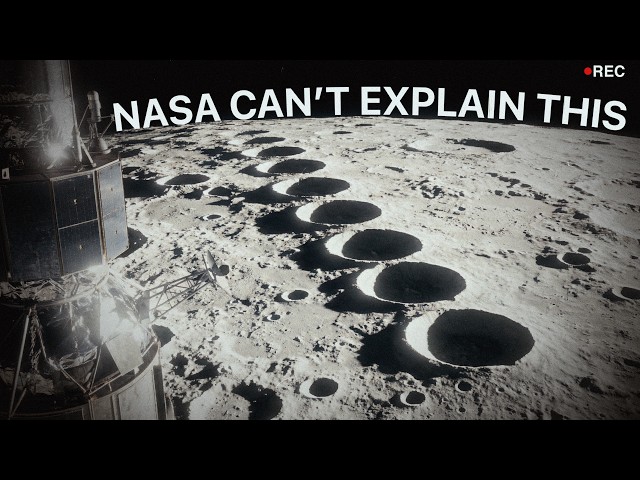
A mysterious image of the Moon’s heavily cratered surface has sparked fascination with one of the most extraordinary journeys in modern space exploration: NASA’s Artemis II mission. The dramatic footage appears to show an enormous collection of dark circular formations scattered across a desolate lunar landscape, while a spacecraft observes the terrain from above. Accompanied by the alarming message “NASA CAN’T EXPLAIN THIS,” the image suggests that astronauts may have encountered something terrifying on the Moon’s mysterious far side. But did Artemis II really discover something impossible hidden beyond Earth’s view, or does the unsettling landscape reveal the Moon’s violent geological history? Although the far side contains extraordinary features, there is no verified evidence that Artemis II astronauts discovered alien structures, mysterious entrances, or unexplained objects resembling those suggested by the viral image.
The Moon’s far side has fascinated scientists for generations. Because the Moon is tidally locked to Earth, the same hemisphere generally faces our planet, leaving the opposite hemisphere permanently hidden from direct observation on the ground. However, the term “dark side” is scientifically misleading. The lunar far side receives sunlight just like the near side, experiencing approximately two weeks of daylight followed by two weeks of darkness during each lunar cycle.
Humanity first photographed the far side in 1959 when the Soviet Luna 3 spacecraft transmitted images of previously unseen lunar terrain. Since then, numerous missions have mapped the region in extraordinary detail, revealing a landscape dramatically different from the familiar face of the Moon.
One of the most striking differences is the abundance of impact craters.
While the Moon’s near side contains extensive dark volcanic plains known as maria, the far side is dominated by rugged highlands and densely cratered terrain. These enormous circular scars preserve evidence of asteroid and comet impacts that occurred over billions of years.
Some craters overlap, forming complicated patterns that can appear almost artificial when viewed from unusual angles. Others contain central peaks, terraced walls, and permanently shadowed regions that create dramatic contrasts between light and darkness.
The image accompanying the sensational headline emphasizes these features, displaying a seemingly endless collection of dark circular openings. Their appearance might suggest enormous tunnels or entrances leading beneath the lunar surface. However, the image is not authenticated as a photograph taken by Artemis II astronauts, and its unusual crater patterns should not be interpreted as evidence of artificial structures.
One of the Moon’s most extraordinary geological features is the South Pole–Aitken basin, a gigantic impact structure spanning approximately 2,500 kilometers. Located primarily on the lunar far side, it ranks among the largest known impact basins in the solar system.
Scientists believe this enormous formation resulted from an ancient collision that excavated material from deep within the Moon. Studying its composition could reveal important information about the lunar crust, mantle, and the violent conditions that shaped the early solar system.
For Artemis II, the far side of the Moon represents both a scientific opportunity and an operational challenge.
The mission is designed to carry four astronauts aboard the Orion spacecraft on a journey around the Moon before returning to Earth. Unlike future Artemis missions intended to land astronauts on the lunar surface, Artemis II is a crewed lunar flyby designed to test spacecraft systems and demonstrate safe human operations beyond low Earth orbit.
During the portion of the flight when the Moon blocks the spacecraft’s direct line of sight to Earth, communications with mission control can be temporarily interrupted. This planned communications blackout is a consequence of the Moon obstructing radio signals, not evidence of an unexplained phenomenon.
For astronauts traveling through this remote region, the experience could be psychologically extraordinary. Earth would disappear behind the Moon, leaving the crew surrounded by the darkness of space and an ancient landscape marked by billions of years of impacts.
The far side also contains geological mysteries that researchers are still working to understand.
Scientists continue investigating why the lunar crust is generally thicker on the far side, why volcanic plains are less extensive there, and how the Moon’s earliest history produced such pronounced differences between its hemispheres.
These questions are genuine scientific mysteries, but they do not require extraterrestrial explanations.
Another fascinating possibility involves lava tubes beneath the lunar surface. Scientists have identified evidence suggesting that underground cavities may exist in some regions of the Moon. Such formations could eventually provide natural shelter for future lunar explorers, protecting them from radiation, micrometeorites, and extreme temperature changes.
However, no confirmed discovery establishes that the circular formations shown in the viral image are entrances to enormous underground civilizations or artificial facilities.
Ultimately, the Moon’s far side is a world of ancient impacts, rugged highlands, and extraordinary geological history, but there is no verified evidence that Artemis II discovered something terrifying or impossible there.
The real significance of lunar exploration lies in understanding how the Moon formed, how its surface evolved, and what its ancient rocks can reveal about the earliest history of Earth and the solar system.
And perhaps the most remarkable discovery awaiting future astronauts will not be evidence of something supernatural, but scientific clues hidden in a landscape that has remained largely unchanged for billions of years.
What do you think? If astronauts exploring the Moon’s far side discovered an enormous underground cavity beneath one of its mysterious craters, would you expect a natural volcanic formation, evidence of ancient geological activity, or something that could completely change our understanding of the Moon? Share your thoughts in the comments!