NASA Releases Photos of “Vegetation” on Mars — What Are We Looking At?
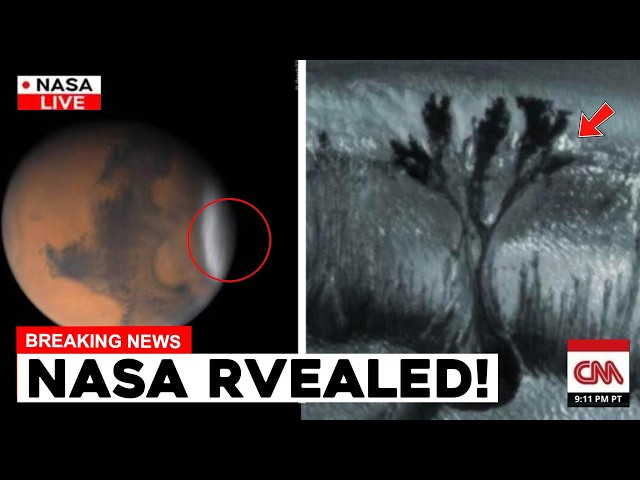
A series of mysterious images from Mars has reignited one of the most fascinating questions in planetary exploration: could the Red Planet be hiding evidence of life in places scientists once considered completely barren? Dramatic photographs circulating online appear to show strange, tree-like formations spreading across the Martian surface, with dark branches resembling forests or vegetation growing in an alien landscape. A sensational image featuring Mars alongside an enlarged view of these unusual structures has encouraged speculation that NASA may have discovered living plants on another world. But has NASA actually photographed vegetation growing on Mars, or are these extraordinary formations the result of natural geological processes that only resemble living organisms? The scientific explanation is remarkable, although there is currently no confirmed evidence of living trees, forests, or other vegetation on Mars.
The mystery surrounding these images is not entirely new. NASA’s Mars Reconnaissance Orbiter, which began studying Mars in 2006, has captured extraordinary high-resolution photographs of the planet’s surface. Among its most intriguing observations are dark, branching patterns that resemble trees, bushes, or enormous root systems. These formations have attracted attention because their shapes appear surprisingly biological, especially when viewed without information about their location or scale.
However, scientists have identified natural processes capable of producing these unusual patterns.
One of the best-known examples involves seasonal carbon dioxide frost near the Martian polar regions. During winter, temperatures become cold enough for carbon dioxide from the atmosphere to freeze onto the surface. When spring arrives, sunlight warms the ground beneath translucent layers of carbon dioxide ice, causing some of the frozen material to transform directly into gas.
As pressure builds beneath the ice, gas can escape through cracks and openings, carrying dark dust and sand toward the surface. Winds then redistribute this material, producing intricate streaks and branching patterns across the landscape.
From orbit, these formations can look astonishingly similar to trees.
Some images also show dark material sliding down slopes as seasonal temperatures change. The resulting deposits may create branching structures that appear to grow outward from a central point, reinforcing the illusion of vegetation.
But these patterns are not confirmed plants, and their appearance does not establish that photosynthesis or biological growth is occurring on Mars.
The distinction matters because Mars presents an extremely challenging environment for life as we understand it.
Its atmosphere is composed primarily of carbon dioxide and is much thinner than Earth’s. Surface temperatures frequently fall far below freezing, while the planet’s limited atmospheric protection allows intense ultraviolet radiation to reach the ground.
Liquid water is generally unstable on the Martian surface under present-day conditions. Although water ice exists in substantial quantities, long-lasting bodies of exposed liquid water have not been confirmed on modern Mars.
These conditions make forests or large plant-like organisms highly unlikely based on current scientific understanding.
Nevertheless, Mars was not always the cold and dry world visible today.
Evidence gathered by NASA’s Curiosity and Perseverance rovers indicates that ancient Mars once possessed rivers, lakes, and environments where liquid water persisted for extended periods. Sedimentary rocks, mineral deposits, and geological formations suggest that some regions may once have provided conditions suitable for microbial life.
This discovery has transformed the scientific search for extraterrestrial biology.
Rather than expecting to find trees growing across the surface, researchers are primarily investigating whether microscopic organisms could have existed billions of years ago, when Mars was warmer and wetter.
NASA’s Perseverance rover is exploring Jezero Crater, a location that once contained a lake and river delta. Scientists selected the site because sedimentary environments can preserve chemical and geological evidence of ancient conditions, including potential biosignatures.
The rover collects and studies rock samples that may help researchers determine whether Mars ever supported microbial life. However, identifying organic molecules or unusual mineral structures does not automatically prove that living organisms were present.
Many organic compounds can form through nonbiological chemical reactions.
The dramatic thumbnail accompanying the viral headline introduces another important issue: the difference between scientific imagery and visual interpretation. The enlarged formation resembles a dark tree with numerous branches, while the accompanying graphics imply that NASA has revealed something extraordinary.
Yet the thumbnail does not establish that the depicted structure is an actual Martian plant. Without the original image, observation date, location, and instrument information, its precise origin cannot be independently verified.
Human perception naturally searches for recognizable shapes in unfamiliar environments. This phenomenon, known as pareidolia, explains why people sometimes see faces in rocks, animals in clouds, or trees in geological patterns.
Mars is particularly well suited to producing these illusions because its surface contains unusual combinations of dust, ice, shadows, erosion features, and ancient geological structures.
The genuine scientific mystery is therefore not whether photographs resembling vegetation exist. They do. The more important question is whether Mars ever developed biological systems capable of surviving its changing environment.
Some scientists consider the possibility that microbial life, if it ever emerged, might have survived underground, where rock and soil could provide protection from radiation and extreme surface conditions.
Future missions equipped with advanced drilling systems and sensitive chemical instruments may help investigate these possibilities.
Ultimately, NASA has photographed extraordinary tree-like formations on Mars, but scientists have not confirmed the discovery of living vegetation on the Red Planet. The unusual patterns are consistent with natural processes involving seasonal frost, gas movement, dust deposits, and geological activity.
And while these formations may not represent alien forests, they demonstrate that Mars remains a dynamic and surprisingly complex world.
The greatest discovery may still lie ahead—not in enormous trees visible from orbit, but in microscopic evidence preserved within ancient Martian rocks.
What do you think? If future Mars missions discovered genuine biological structures beneath the planet’s surface, would you expect ancient microbial fossils, organisms surviving underground, or an entirely unfamiliar form of extraterrestrial life? Share your thoughts in the comments!